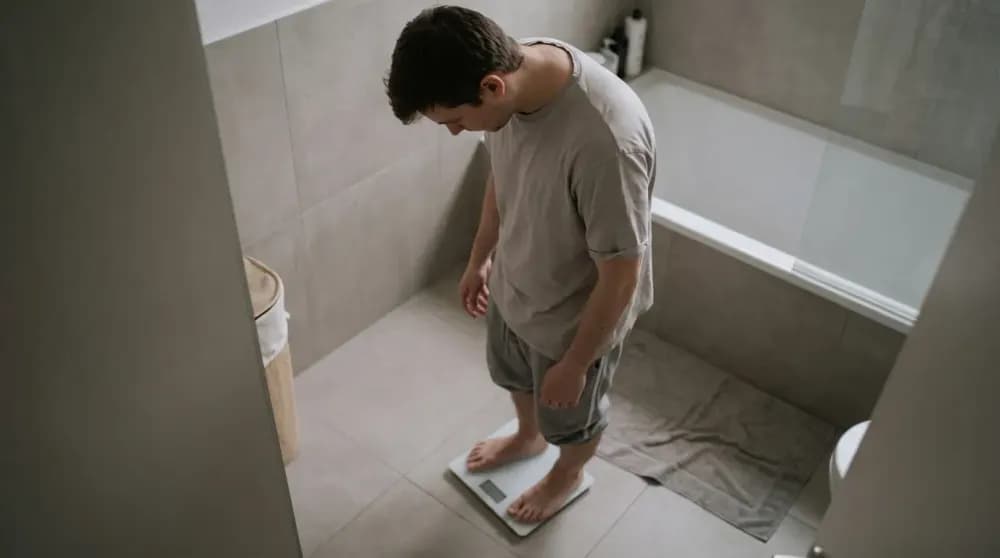
You're eating less, training regularly, and the scale isn't moving. This is one of the most frustrating experiences in fitness, and it's far more common than the straightforward "eat less, move more" narrative suggests. Weight loss stalls have specific, well-documented physiological and behavioral causes. Understanding them is the first step to breaking through them. This guide covers the real reasons progress stops and exactly what to do about each one.
When you restrict calories, your body does not simply burn through stored fat at a predictable rate. It adapts. Resting metabolic rate drops, non-exercise activity decreases, and hormone levels shift in ways that make further weight loss progressively harder. This process is called adaptive thermogenesis or metabolic adaptation, and it is one of the most well-documented phenomena in obesity research.
A
2009 study by Redman et al. published in PLOS ONE measured metabolic and behavioral adaptations in free-living participants under controlled caloric restriction. The study found that total daily energy expenditure fell by 431 kcal/day at 3 months and 240 kcal/day at 6 months, significantly more than the reduction in body mass alone would explain. This metabolic adaptation means your 500-calorie deficit gradually becomes a 200-calorie deficit as your body compensates, even when you maintain the same eating and training habits.
The practical consequence: a calorie deficit that produced 1 lb per week of weight loss in month one may produce no weight loss at all by month four, not because you failed, but because your metabolic rate adjusted downward.
What to do:
- Take a planned diet break every 6-8 weeks. Eating at maintenance for 10-14 days partially reverses metabolic adaptation and restores leptin levels without meaningful fat regain.
- Incorporate resistance training throughout your fat loss phase. Muscle tissue is the primary driver of resting metabolic rate, and preserving it during a deficit directly counteracts the metabolic slowdown. A full body strength workout with compound lifts is the most effective tool for this.
- Avoid deficits larger than 500 calories per day. Larger deficits accelerate metabolic adaptation disproportionately and increase muscle loss risk.
Reason 2: You're Eating More Than You Think
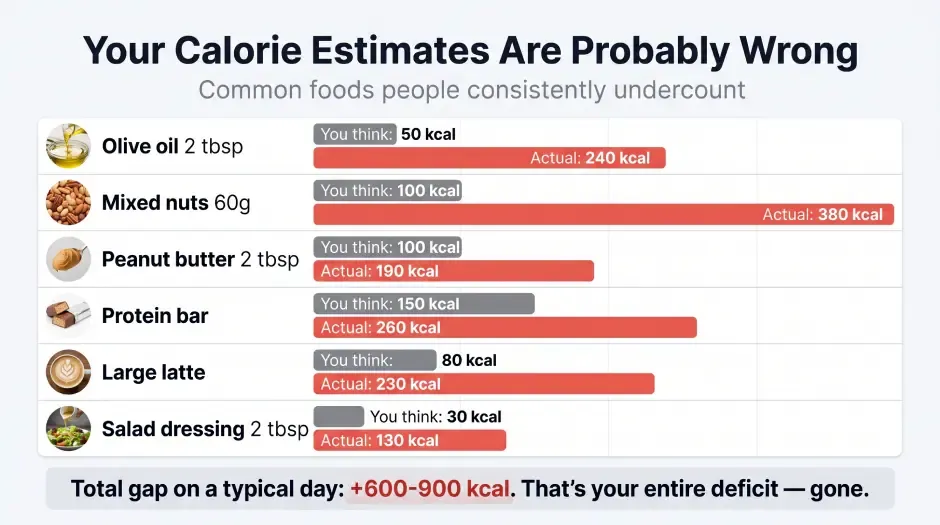
Calorie tracking research consistently shows that people underestimate their food intake by 20-40%. This is not dishonesty. It is a combination of portion estimation errors, forgotten bites and drinks, cooking oil, condiments, and foods that are easy to undercount (nuts, cheese, salad dressings, protein bars).
In practice, this means someone who believes they are eating 1,800 calories per day may be consuming 2,200-2,400 calories. At a maintenance level of 2,000 calories, they are not in a deficit at all.
Common sources of uncounted calories:
| Source | Perceived Calories | Actual Calories |
|---|
| Olive oil (2 tbsp, "a drizzle") | ~50 kcal | 240 kcal |
| Mixed nuts ("a handful", ~60g) | ~100 kcal | 380 kcal |
| Peanut butter (2 tbsp) | ~100 kcal | 190 kcal |
| Protein bar ("low calorie" option) | ~150 kcal | 220-280 kcal |
| Latte with whole milk (large) | ~80 kcal | 200-250 kcal |
| Salad dressing (2 tbsp) | ~30 kcal | 100-150 kcal |
What to do:
- Track food intake with a kitchen scale for 2-3 weeks, not measuring cups. Volume measurements for calorie-dense foods are systematically inaccurate.
- Log everything, including cooking fats, drinks other than water, and bites taken while preparing food.
- After 2-3 weeks of honest tracking, you will have a realistic picture of your actual intake. Adjust from that baseline, not from your estimate.
Reason 3: Poor Sleep Is Sabotaging Your Appetite Hormones
Sleep is not a passive variable in weight loss. It directly regulates the hormones that control hunger and satiety, and disrupting it makes maintaining a calorie deficit significantly harder.
A landmark
2004 study by Taheri et al. published in PLoS Medicine analyzed 1,024 participants from the Wisconsin Sleep Cohort and found that people sleeping 5 hours per night had 15.5% lower leptin (the satiety hormone) and 14.9% higher ghrelin (the hunger hormone) compared to those sleeping 8 hours. This hormonal shift was independent of BMI and directly associated with increased appetite and weight gain.
Simply put: when you sleep less, you feel hungrier, and your brain's reward response to high-calorie food increases. A 300-400 calorie surplus that feels like a neutral eating day when well-rested becomes difficult to prevent when chronically sleep-restricted.
What to do:
- Treat sleep as a dietary variable. 7-9 hours per night is not a luxury, it is a fat loss tool.
- Maintain a consistent sleep and wake schedule, including weekends. Irregular sleep timing disrupts circadian regulation of appetite hormones even when total hours are adequate.
- Reduce caffeine after 1pm and avoid screens in the 60-90 minutes before bed.
Reason 4: You're Not Eating Enough Protein
Protein is the most satiating macronutrient per calorie. It also has the highest thermic effect (20-30% of calories consumed are burned during digestion), meaning higher protein intake directly increases daily energy expenditure. In a deficit, adequate protein preserves muscle mass, which protects your metabolic rate from declining further.
Most people who are not losing weight despite apparent calorie control are not eating enough protein. They fill their calories with carbohydrates and fat, which are less satiating, produce less thermic effect, and do not protect lean mass during restriction.
| Protein Intake | Satiety Effect | Muscle Preservation | Thermic Effect |
|---|
| Under 0.5g/lb bodyweight | Poor | Inadequate | Low |
| 0.5-0.7g/lb bodyweight | Moderate | Partial | Moderate |
| 0.7-1g/lb bodyweight | Strong | Good | High |
| 1-1.2g/lb bodyweight (cutting phase) | Very strong | Optimal | High |
Target 0.8-1.2g of protein per pound of body weight during a fat loss phase. Distribute across 3-4 meals with a minimum of 30-40g per sitting.
Reason 5: Stress and Cortisol Are Storing Fat
Chronic psychological stress elevates cortisol, which promotes fat storage, particularly in the visceral (abdominal) region, increases appetite for high-calorie foods, and drives muscle catabolism. This means chronic stress simultaneously makes you fatter, hungrier, and weaker, directly undermining every component of a fat loss program.
The mechanism is specific: elevated cortisol activates lipoprotein lipase (LPL) in abdominal fat cells, increasing their capacity to store fat, while simultaneously reducing insulin sensitivity and increasing glucose-driven fat deposition.
For people who "do everything right" and still cannot lose weight, unmanaged stress is frequently the variable they have not accounted for. Work stress, relationship stress, financial stress, and training stress (overtraining) all activate the same cortisol pathway.
What to do:
- Audit your total training volume. More exercise is not always better during high-life-stress periods. Reducing training to 3 moderate sessions per week and prioritizing recovery often produces better fat loss results than adding a fourth hard session.
- Add structured stress management: 10-20 minutes of daily walking, breathwork, or any genuinely restorative activity that reduces perceived stress.
- Avoid aggressive deficits during periods of high psychological stress. The combined cortisol load of life stress plus large calorie restriction is often counterproductive for fat loss.
Body weight fluctuates by 1-4 lbs daily due to water retention, glycogen storage, sodium intake, hormonal cycles, and digestive contents. A single weigh-in means nothing. Even a week of flat scale readings may coincide with genuine fat loss that is masked by temporary water retention.
People who "stop losing weight" often mistake a flat scale trend for a plateau when actual fat loss is still occurring. Conversely, a downward scale trend can mask muscle loss if body composition is not tracked separately.
A more complete tracking system:
| Metric | Frequency | What It Shows |
|---|
| Scale weight (average) | Daily, use 7-day rolling average | Fat + water + muscle trend |
| Waist circumference | Every 2 weeks | Visceral fat change |
| Progress photos | Every 4 weeks (same conditions) | Body composition visually |
| Gym performance | Every session | Muscle preservation indicator |
| How clothes fit | Ongoing | Practical composition change |
If your 7-day average weight is flat for 3+ weeks AND measurements are not changing AND training performance is declining, you have a genuine plateau. If only the scale is flat but measurements or photos show change, fat loss is still occurring.
If your scale weight has stalled but your goal is getting leaner without sacrificing strength, follow our clinical protocol on
how to lose weight without losing muscle and verify your actual deficit using the
FitWay Daily Calorie & TDEE Calculator.
Conclusion
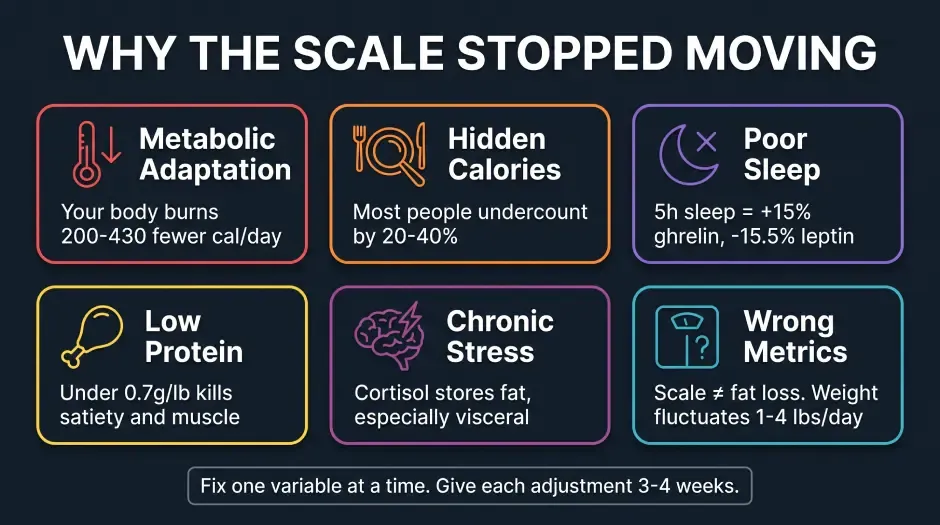
Weight loss stalls are almost always explained by one or more of six factors: metabolic adaptation, untracked calorie intake, poor sleep disrupting appetite hormones, insufficient protein, elevated cortisol from stress or overtraining, and measurement error. Each has a specific fix. Identify which applies to your situation, address it systematically, and give the adjustment 3-4 weeks to produce a measurable response. Progress in fat loss is not linear, but it is diagnosable. If you are doing a structured program such as a
beginner functional HIIT routine for fat loss or a
full body strength program and progress has stalled, work through this list before changing your program.
Frequently Asked Questions
How long does a true weight loss plateau last and when should I change something?
A genuine plateau, where fat loss has stopped despite consistent calorie deficit and training, typically requires 3-4 weeks of flat measurements (not just scale weight) before it warrants an adjustment. Short-term scale fluctuations of 1-7 days are almost always water, glycogen, or hormonal variation, not true stalls. If your 7-day average weight, waist measurement, and progress photos are all flat after 3-4 consistent weeks, the first adjustments to try are a 2-week diet break at maintenance calories (to reset metabolic adaptation and leptin), followed by resuming the deficit. Only increase cardio or reduce calories further as a last step, and even then by no more than 100-150 calories at a time.
Can I lose fat if I stop seeing the scale move?
Yes. Body recomposition, where fat is lost and muscle is gained simultaneously, is particularly common in beginners and people returning to training after a break. In this scenario, scale weight remains flat or even increases while body fat percentage drops. The most reliable way to identify this is tracking multiple metrics: waist circumference and progress photos will show fat loss while the scale does not. If you are doing consistent resistance training with adequate protein (0.8-1g per lb of body weight), a flat or slowly rising scale with improving physique measurements almost always means recomposition is occurring, which is a better outcome than simple weight loss.
Does eating too little stop weight loss?
Yes, through two mechanisms. First, extreme calorie restriction accelerates metabolic adaptation, reducing total daily energy expenditure by several hundred calories within weeks. Second, very low calorie intake (under 1,200 calories for most women, under 1,500 for most men) leads to significant muscle loss, which further reduces resting metabolic rate and creates a progressively worse metabolic situation. The body also increases production of hunger hormones under severe restriction, making the deficit psychologically unsustainable. A moderate deficit of 300-500 calories, not a severe one, produces better long-term fat loss outcomes because it minimizes both muscle loss and metabolic adaptation.