A calorie deficit is the one thing every successful fat loss plan has in common, yet most people either guess their numbers or copy a generic 1,500-calorie plan from the internet. The result is a deficit that is too big to sustain or too small to show on the scale. This guide explains what a calorie deficit is, shows you how to calculate yours with a worked example, and explains why your first number is a starting estimate you will adjust, not a promise.
What Is a Calorie Deficit?
A calorie deficit means you eat fewer calories than your body uses over time. Your body spends energy in four ways:
- Basal metabolic rate (BMR): the energy needed to keep you alive at rest
- Thermic effect of food: the energy used to digest and absorb meals
- Exercise: planned workouts
- Daily movement: walking, chores, fidgeting, standing
Add them together and you get your total daily energy expenditure (TDEE), also called maintenance calories. When you eat below TDEE consistently, your body covers the gap with stored energy, mostly body fat. Eat above it and the surplus gets stored. The hard part is not the principle. It is estimating TDEE well and then eating to a number you can keep up for weeks, not days.
How to Calculate Your Calorie Deficit
Three steps get you from your height and weight to a daily calorie target.
Step 1: Estimate your BMR
The
Mifflin-St Jeor equation was derived from indirect calorimetry measurements in
498 healthy adults, including both normal-weight and obese participants, and it remains one of the most widely used formulas for resting energy expenditure. Use metric units:
- Men: BMR = 10 x weight (kg) + 6.25 x height (cm) - 5 x age + 5
- Women: BMR = 10 x weight (kg) + 6.25 x height (cm) - 5 x age - 161
Step 2: Multiply by an activity factor
Multiply your BMR by the factor that matches a typical week, not your best week. Most people overrate their activity level, so when you are between two rows, pick the lower one.
| Activity level | Multiplier | Typical week |
|---|
| Sedentary | ~1.2 | Desk job, little or no exercise |
| Lightly active | ~1.375 | 1-3 workouts per week |
| Moderately active | ~1.55 | 3-5 workouts per week |
| Very active | ~1.725 | 6-7 hard sessions or a physical job |
Step 3: Subtract your deficit
BMR multiplied by the activity factor gives your estimated TDEE. Subtract a percentage of it to get your daily target. The
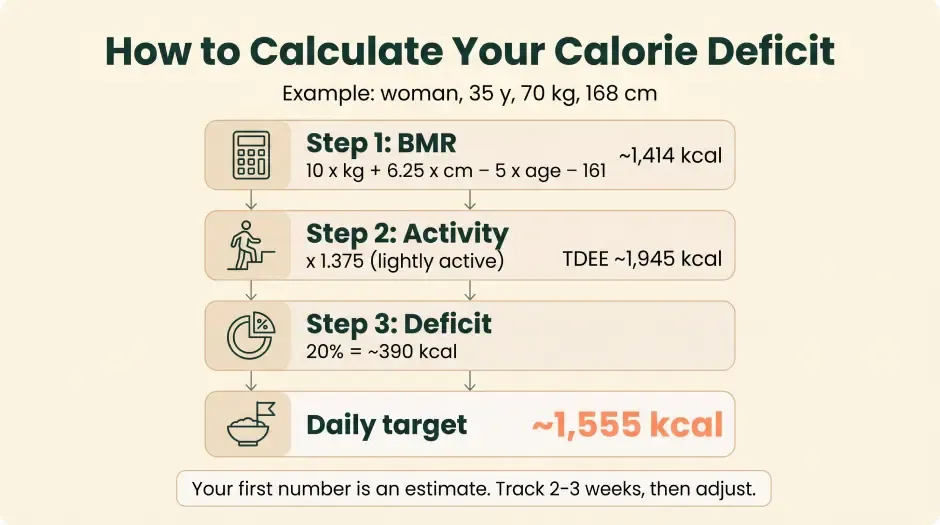
daily calorie needs calculator on FitWay does this math for you and returns maintenance, weight loss, and weight gain targets. Here is a worked example for a 35-year-old woman who weighs 70 kg, is 168 cm tall, and trains 1-3 times a week:
- BMR = 700 + 1,050 - 175 - 161 = ~1,414 kcal
- TDEE = 1,414 x 1.375 = ~1,945 kcal
- A 20% deficit is ~390 kcal, so her target is ~1,555 kcal per day
How Big Should Your Calorie Deficit Be?
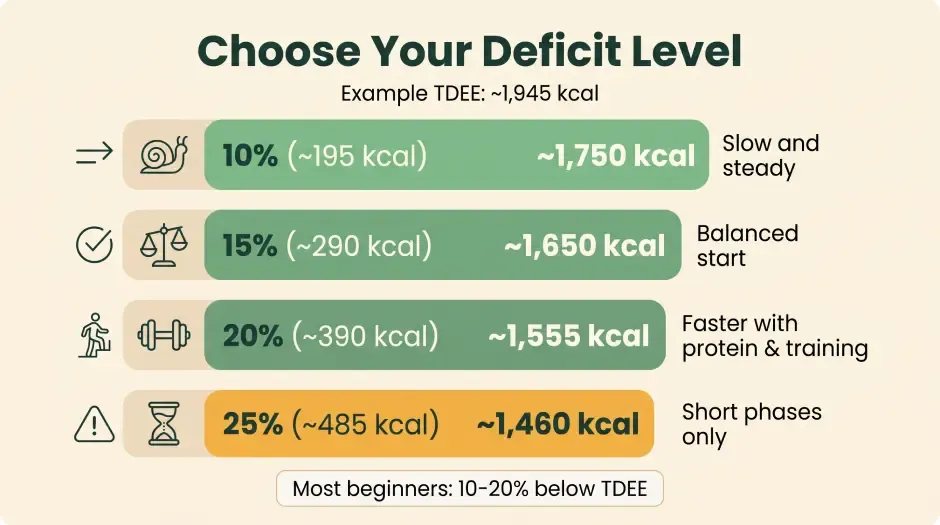
A bigger deficit is not automatically better. Larger cuts make hunger, low energy, and missed workouts more likely, and a plan you abandon in week three loses to a smaller plan you follow for six months. The table below applies four common deficit sizes to the example above.
| Deficit | Daily target (example) | Best for |
|---|
| 10% (~195 kcal) | ~1,750 kcal | Slow, steady loss and easy adherence |
| 15% (~290 kcal) | ~1,650 kcal | A balanced starting point |
| 20% (~390 kcal) | ~1,555 kcal | Faster loss with solid protein and training |
| 25% (~485 kcal) | ~1,460 kcal | Short phases only, harder to sustain |
For most beginners,
10-20% below TDEE is a sensible range. If your target comes out very low, many dietitians use about 1,200 kcal for women and 1,500 kcal for men as a point to involve a professional rather than going lower alone. This is general information, not medical advice. If you are pregnant, under 18, have a medical condition, or have a history of disordered eating, talk to a healthcare professional before cutting calories.
Why Your Calorie Deficit Is an Estimate
Every formula gives an average, and your real maintenance level can sit a few hundred calories above or below it. Two research findings explain why you should treat your first target as a hypothesis.
Food logs are usually wrong. In a
study of 10 obese adults who reported eating under 1,200 kcal a day yet were not losing weight, researchers measured intake and expenditure over 14 days. Their metabolism was within 5% of predicted values. The problem was reporting: they underreported food intake by about 47% and overreported physical activity by about 51%. The sample was small, but the pattern is a useful warning that estimating portions by eye often hides hundreds of calories.
Weight responds slowly. A
modeling study in The Lancet found that body weight reacts gradually to a change in energy intake, with a half-time of about 1 year, partly because energy expenditure adapts as weight comes off. The authors argued that simple fixed rules of thumb have created unrealistic expectations. In practice, expect your loss to be steady rather than linear, and expect to adjust your calories as your body weight changes.
How to Keep Muscle While Eating Less
A deficit does not decide what you lose. Protein and training do. In a
4-week randomized trial of 40 young men, both groups ate about 40% below their energy needs and trained intensely. The group eating 2.4 g of protein per kg of body weight per day lost more fat (4.8 kg vs 3.5 kg) than the group eating 1.2 g per kg, and also gained more lean mass (about 1.2 kg vs 0.1 kg).
Treat the numbers with care: the trial was short, used young men, and involved a very high training volume and a very large deficit. Most people do not need 2.4 g per kg. A range of roughly 0.7-1 g per pound of body weight (1.6-2.2 g per kg) is widely used in sports nutrition, and it pairs well with a
full-body strength workout two to four times a week.
Practical Tips: How to Run Your Deficit
What to do:
- Weigh and measure your food for 2 weeks. You do not have to do it forever, but it calibrates your eye and exposes hidden calories like oils, sauces, and drinks.
- Track a weekly average, not a daily number. Weigh yourself most mornings and compare weekly averages. Water, salt, and digestion move the scale by a kilo or more overnight.
- Measure your waist every 2 weeks. It shows fat change when the scale stalls.
- Hold your target for 2-3 weeks before changing it. If your weekly average is not trending down, cut 100-150 kcal or add daily steps, not both at once.
- Build meals around protein and fiber. They help you feel full on fewer calories.
- Use movement to widen the gap. A daily walk adds to expenditure without adding hunger. For conditioning, a beginner functional HIIT workout fits into a deficit without long cardio sessions.
Conclusion
A calorie deficit is simple to define and easy to get wrong in practice. Estimate your TDEE with Mifflin-St Jeor, apply a 10-20% deficit, track honestly for two to three weeks, and adjust from your real results instead of the formula. Keep protein high and keep lifting so the weight you lose is mostly fat. Track your progress with FitWay and see results faster.
Frequently Asked Questions
How many calories should I cut to lose weight?
Start with a deficit of 10-20% below your estimated maintenance calories. For many adults that is roughly 200-500 kcal per day. Calculate your TDEE first, then subtract a percentage rather than a fixed number, because the same 500 kcal cut is gentle for a large, active person and aggressive for a small, sedentary one. Hold the target for 2-3 weeks, compare your weekly average weight, and adjust by 100-150 kcal only if the trend is flat.
Is a 500-calorie deficit too much?
It depends on your maintenance level. A 500 kcal deficit is about 18% for someone with a TDEE near 2,800 kcal, which is a reasonable range, but it is about 26% for someone near 1,945 kcal, which is aggressive and harder to sustain. Check the percentage, not just the number. If you feel constantly hungry, tired, or start skipping workouts, shrink the deficit. People with medical conditions should ask a doctor first.
How long does it take to lose weight in a calorie deficit?
Expect to wait 2-3 weeks before the trend is clear. Daily weight swings from water and digestion can hide fat loss at first. Research modeling shows body weight keeps adjusting for months after an intake change, with a half-time of about 1 year, so progress is gradual. Compare weekly averages and waist measurements instead of single weigh-ins. If nothing has moved after 3 weeks of accurate tracking, lower your target slightly or increase your daily movement.