Step into almost any commercial gym, and you will see rows of people grinding away on treadmills and ellipticals, convinced that endless sweat sessions are the only way to melt stubborn body fat. For decades, traditional fitness advice treated steady cardio as the golden ticket to a leaner physique. Yet countless trainees log hours on the track every single week without seeing the scale budge. The truth about cardio and fat loss is much more nuanced than the simplistic "calories in versus calories out" formula suggests. While cardiovascular work plays an indispensable role in heart health, aerobic capacity, and energy expenditure, relying on it as your sole fat loss vehicle often leads to burnout, muscle loss, and metabolic frustration. Understanding how your metabolism responds to aerobic exercise allows you to stop spinning your wheels and finally build a sustainable strategy.
The Energy Balance Equation and the Aerobic Illusion
At its core, fat loss requires a sustained net energy deficit. Your body must mobilize stored adipose tissue to meet its daily energy demands. Cardio burns calories while you perform it, which is why it became the default prescription for weight management. A 45-minute jog may burn roughly 350 to 500 calories depending on your body weight and intensity. On paper, repeating this session four times per week creates a 1,600-calorie deficit, which should theoretically translate to measurable body fat loss over a month.
However, real human physiology rarely behaves like a clean math spreadsheet. In a landmark 10-month randomized controlled trial published in
Obesity, researchers observed participants performing supervised aerobic exercise burning either 400 or 600 calories per session five days per week without dietary restrictions. While participants lost an average of 3.9 kg and 5.2 kg respectively, individual responses varied wildly. Some individuals lost substantial amounts of fat, whereas others lost almost none despite complete compliance. The discrepancy stems from two major physiological realities: dietary compensation and metabolic adaptation.
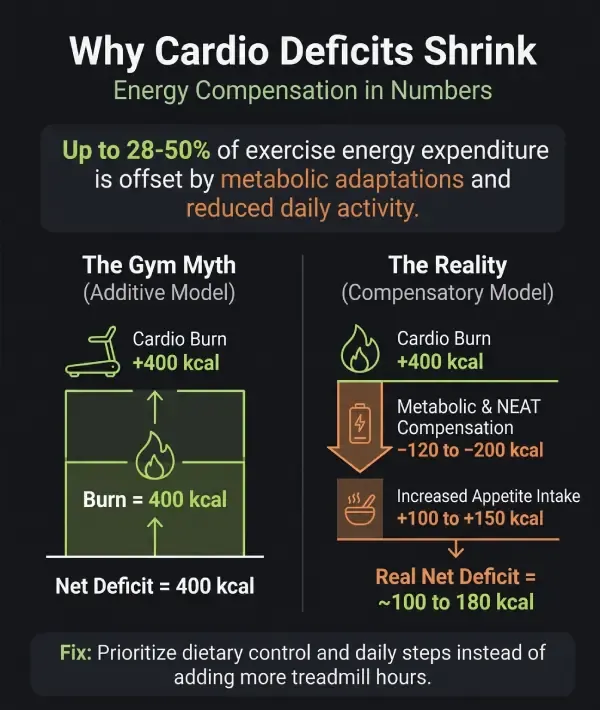
When you dramatically ramp up cardio volume, your body protects its energy reserves through powerful survival mechanisms. Appetite-regulating hormones such as ghrelin frequently increase, prompting you to subconsciously eat back the burned calories. Just as importantly, many people experience an involuntary drop in non-exercise activity thermogenesis (NEAT). After an exhausting 60-minute treadmill session, you are far more likely to spend the rest of the day lying on the couch, taking the elevator, and fidgeting less. If you burn 400 calories on the stairmaster but subconsciously reduce your daily NEAT by 300 calories, your net daily deficit shrinks to almost nothing.
Constrained Energy Expenditure: Why More Cardio Yields Diminishing Returns
For years, fitness professionals assumed the additive model of energy expenditure: the more physical activity you perform, the higher your total daily energy expenditure (TDEE) climbs in a linear fashion. Groundbreaking anthropological and metabolic research led by Herman Pontzer, detailed in
Current Biology, challenged this fundamental assumption by introducing the Constrained Model of Total Energy Expenditure.
Pontzer and his colleagues studied hunter-gatherer populations like the Hadza of Northern Tanzania, who walk thousands of steps daily across rugged terrain. Surprisingly, their total daily energy expenditure was virtually identical to sedentary office workers in Western countries after adjusting for body size. The human body dynamically adapts to chronic high activity by throttling background energetic costs, including reproductive signaling, inflammatory processes, and stress responses.
| Cardio Approach | Primary Energy Fuel | Calorie Burn Ceiling | Muscle Retention Impact |
|---|
| Low-Intensity Steady State (LISS) | Primarily free fatty acids | High time requirement | Neutral to positive if volume is moderate |
| High-Intensity Interval Training (HIIT) | Glycogen and blood glucose | Limited by central fatigue | Favorable for power and fast-twitch fibers |
| Excessive Endurance Volume (10+ hrs/wk) | Mixed carbohydrates and fats | Constrained energy kicks in | High risk of muscle catabolism and high cortisol |
Further research published in
Current Biology evaluated energy compensation across 1,754 adults and discovered that on average, only about 72% of the calories burned during physical activity translated into extra total daily expenditure. Among individuals with higher levels of body fat, this compensation rate reached upwards of 50%, meaning half of the calories burned during exercise were offset by background metabolic reductions. Grinding through double cardio sessions does not double your fat loss rate; your body compensates by conserving energy elsewhere.
The "Fat-Burning Zone" Myth vs Real-World Fat Loss
Almost every modern cardio machine features a display showing the famous "Fat-Burning Zone," typically targeting 60% to 70% of maximum heart rate. This concept has misled gym-goers for decades. It is true that lower-intensity aerobic activity derives a higher percentage of its fuel from circulating free fatty acids rather than stored glycogen. However, fat loss is not dictated by what fuel substrate you burn while on the machine; it is governed by net 24-hour energy deficit and overall body composition preservation.
Consider the contrast between a light 30-minute walk and a 20-minute interval workout. During the walk, 60% of your energy might come from fat, burning approximately 120 total calories (72 calories from fat). During higher-intensity intervals, fat oxidation may drop to only 35%, but total energy turnover surges to 280 calories (98 calories from fat). More importantly, higher-intensity work stimulates metabolic conditioning and insulin sensitivity across a shorter training window.
If you prefer high-intensity intervals for efficiency, pairing quick cardio intervals with targeted functional movements helps elevate conditioning without draining your recovery bank. For instance, incorporating a structured
functional HIIT bodyweight fat loss workout allows you to build aerobic power, tax core stability, and maintain mobility in half the time of long treadmill grinds.
The Muscle Loss Dilemma: Why Cardio Alone Ruins Body Composition
When people declare they want to lose weight, what they almost universally mean is that they want to lose adipose tissue while looking firm, athletic, and healthy. Dropping weight strictly through heavy cardio and aggressive dieting frequently produces a "skinny-fat" outcome, leaving you with lower scale weight but higher relative body fat percentage and a sluggish basal metabolic rate.
Skeletal muscle tissue is metabolically active and functionally protective. When you place your body in a caloric deficit and perform exclusively aerobic endurance work, your body has no physiological reason to hold onto dense, calorically expensive muscle mass. In fact, prolonged endurance sessions elevate circulating cortisol, which can accelerate the breakdown of muscle protein if overall recovery and nutrition are compromised.
Resistance training provides the critical stimulus that tells your brain:
we need this muscle to survive physical loads. If you are just starting your fitness path, building a weekly schedule around a
beginner strength training gym foundation routine creates the mechanical tension needed to lock muscle tissue in place while your nutrition takes care of the caloric deficit. Every pound of muscle you preserve keeps your resting metabolic rate higher and ensures that the weight you drop is purely body fat.
Practical Framework: How to Program Cardio for True Fat Loss
Cardio is not useless; it is simply a tool that must be assigned its proper job. Rather than using aerobic work as punishment for what you ate or as your primary weight reduction engine, use it to bolster cardiovascular health, boost recovery, and enhance daily energy flux. Here is how to construct a balanced routine that protects muscle while maximizing fat loss:
- Establish your nutrition baseline first. Manage your energy intake in the kitchen. Creating a moderate 300 to 500 calorie deficit through whole foods, adequate fiber, and lean protein is far more reliable and time-efficient than trying to burn off excess calories on the treadmill.
- Lift weights 3 to 4 times per week. Focus on progressive resistance training with multi-joint movements. If you train at home with limited equipment, executing a structured beginner HIIT workout at home with dumbbells and bands provides both resistance stimulus and cardiovascular conditioning without cannibalizing lean tissue.
- Prioritize non-exercise steps (NEAT). Aim for 7,000 to 10,000 daily steps through casual walking, taking phone calls on foot, and moving consistently throughout the workday. Low-intensity walking does not trigger compensatory hunger spikes or chronic central nervous system fatigue.
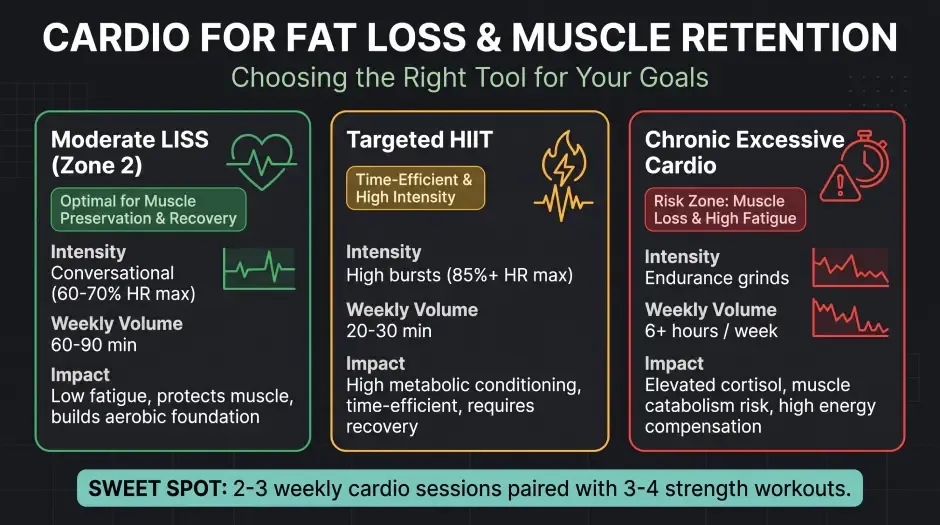
- Keep dedicated cardio focused and moderate. Limit dedicated cardiovascular sessions to 2 to 3 times per week for 20 to 35 minutes. You can split this between Zone 2 aerobic base building (conversational jogging or incline walking) and one shorter session of high-intensity intervals.
- Consume sufficient dietary protein. Target 1.6 to 2.2 grams of protein per kilogram of body weight (0.7 to 1.0 grams per pound) daily. Protein preserves lean muscle mass during energy deficits and increases satiety, preventing post-workout overeating.
Conclusion
Cardiovascular exercise is one of the best tools on earth for improving heart function, lung capacity, mental health, and insulin sensitivity. However, using cardio as your primary weapon for fat loss is an inefficient, uphill battle against evolutionary biology and metabolic compensation. Real, lasting fat loss is built on a manageable caloric deficit, progressive resistance training to protect muscle, and consistent daily movement. Treat cardio as a partner to your overall health rather than a desperate remedy for fat loss. Start your fitness journey with the FitWay app today, get a personalized training plan that balances strength and conditioning, and build a lean, athletic body that lasts.
Frequently Asked Questions
Can you lose body fat doing only cardio and no weight lifting?
Yes, you can lose weight doing only cardio if you maintain a consistent caloric deficit, but a significant portion of that lost weight will likely come from lean muscle tissue rather than pure fat. Losing muscle lowers your resting metabolic rate and often results in a softer physical appearance rather than an athletic shape. Combining cardio with resistance training ensures that the weight you drop is almost entirely adipose tissue.
Is fasted cardio in the morning better for burning belly fat?
No, performing cardio on an empty stomach does not accelerate overall fat loss compared to fed cardio when total 24-hour calorie intake is equal. While exercising in a fasted state can acutely increase the percentage of fat oxidized during the session, your body adjusts fuel utilization over the remainder of the day by burning more carbohydrates. The total caloric deficit at the end of the week remains the true deciding factor for fat loss.
How many minutes of cardio per week should I do to drop fat?
Aim for 60 to 120 minutes of moderate-intensity cardio per week, divided into two or three manageable sessions, alongside consistent strength training. Exceeding this amount frequently leads to diminished returns due to metabolic energy compensation, increased appetite, and joint fatigue. Pairing this cardio volume with 7,000 to 10,000 daily steps is more than enough to support optimal fat loss without risking burnout.