Everyone who trains regularly has had that moment: the alarm goes off, you're tired, work was hard, and the last thing you want to do is exercise. Most fitness content responds to this with encouragement. Psychology research responds with something more useful: a precise explanation of why motivation fails and exactly what to do instead. This guide covers the science of exercise motivation, what drives long-term consistency, and the specific behavioral techniques that actually work when willpower runs out.
Why Motivation Is the Wrong Thing to Rely On
Motivation is a feeling, and feelings fluctuate. Relying on motivation to get to the gym is like relying on being in a good mood to do your taxes. It works occasionally, but it's not a system.
The evidence supports this view clearly. A
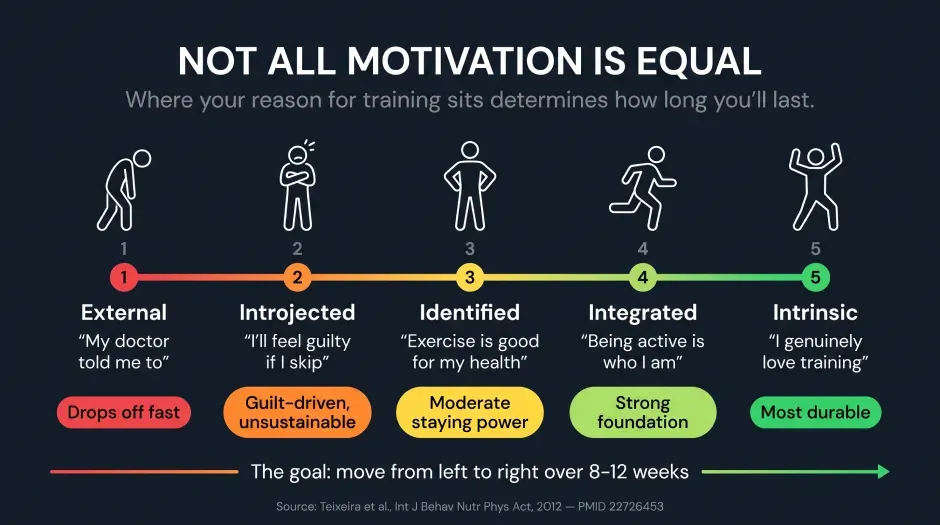
2012 systematic review by Teixeira et al. published in the International Journal of Behavioral Nutrition and Physical Activity analyzed 66 studies on exercise motivation and found a critical distinction:
extrinsic motivation (training to lose weight, look better, or please someone else) predicts short-term exercise adoption, but
intrinsic motivation (training because you find it genuinely rewarding, enjoyable, or meaningful) is what predicts long-term adherence.
The practical implication is significant. People who exercise because they feel they should, or because they want to change how they look, tend to drop out within weeks to months when results are slow or life gets difficult. People who train because it makes them feel capable, energized, or connected to an identity tend to stay consistent for years.
This does not mean aesthetic or health goals are invalid. It means they work better as a starting point than as a long-term driver. The goal is to gradually shift from training because you want to change something about yourself, to training because of what it gives you in the process.
Self-Determination Theory: The Three Needs That Drive Consistency
The Teixeira et al. review is grounded in Self-Determination Theory (SDT), a psychological framework developed by Deci and Ryan that identifies three basic psychological needs whose satisfaction predicts intrinsic motivation in any domain, including exercise:
Autonomy: the sense that your exercise choices are self-directed rather than controlled or imposed. People who choose their workouts, their schedule, and their approach stay consistent longer than those following a rigid program they did not choose. This is why coaching works better when it explains the why behind prescriptions, and why you should pick a training style you actually enjoy over the one someone else told you is optimal.
Competence: the sense that you are improving and capable. This is why beginners often quit before gaining competence but those who stay through the initial awkward phase develop momentum. Tracking progress, noticing strength gains, and celebrating small wins all directly feed the competence need. A
beginner strength training foundation program gives new trainees the fastest path to feeling competent because it has measurable, achievable progressions built in from the start.
Relatedness: the sense of connection to others who share the activity. Group classes, training partners, and online communities all increase exercise adherence through this mechanism. You are not just exercising, you are doing something with people who matter to you or whose opinion you value.
Satisfying these three needs does not just make exercise feel better. It restructures your relationship with training from something you do to something you are.
Motivation research has a practical problem: understanding why people stay motivated is interesting, but what actually works to bridge the gap between wanting to exercise and doing it?
The most robust answer from behavioral science is the implementation intention, a specific type of planning first studied by Peter Gollwitzer. The key experiment on exercise was conducted by Milne, Orbell and Sheeran (British Journal of Health Psychology, 2002): 248 participants were split into three groups. One group simply tracked their exercise. A second group received motivational information about the benefits of exercise. The third group received the same motivational information and also formed an implementation intention by writing down exactly when, where, and how they would exercise in the next week.
The results were striking. The motivational information alone produced no significant increase in actual exercise compared to the control group. The group that formed implementation intentions reported 91% follow-through versus 35% in the other groups. The researchers concluded: "Motivation had no significant effects on exercise behavior" without the concrete planning component.
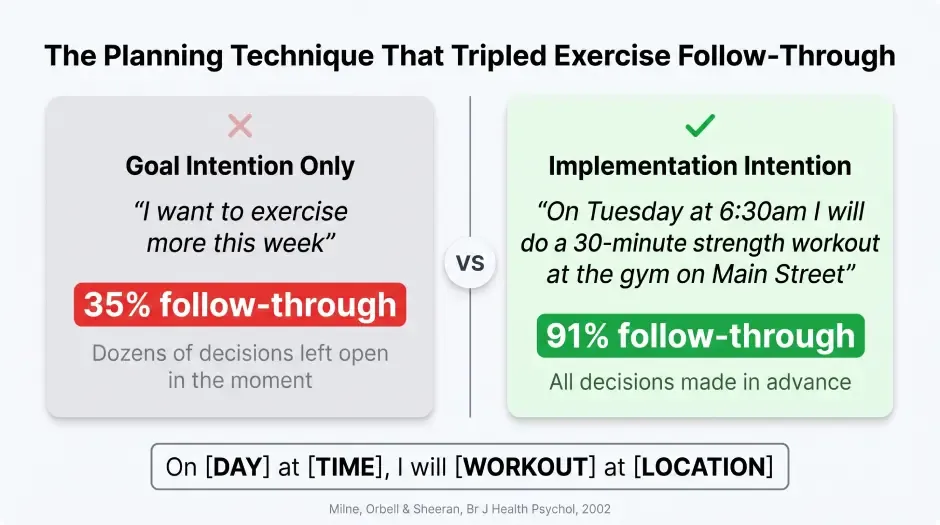
An implementation intention follows this format:
"During [specific day and time], I will [specific exercise] at [specific location]."
Examples:
- "On Monday and Thursday at 6:30am, I will do the beginner full body strength workout at the gym near work."
- "On Tuesday and Friday at 7pm, I will do the beginner HIIT workout at home in my living room."
The specificity is the mechanism. A vague intention leaves dozens of micro-decisions open in the moment (when, where, what, for how long), each of which is an opportunity to opt out. An implementation intention collapses all of those decisions in advance, so showing up requires almost no mental energy.
Motivation Type vs Adherence: What the Evidence Shows
| Motivation Type | Example | Short-Term Adherence | Long-Term Adherence |
|---|
| External regulation | "My doctor said I have to" | Low | Very low |
| Introjected regulation | "I'll feel guilty if I skip" | Moderate | Low |
| Identified regulation | "Exercise is important for my health" | Moderate-high | Moderate |
| Integrated regulation | "Being active is part of who I am" | High | High |
| Intrinsic motivation | "I genuinely enjoy training" | High | Very high |
The table above maps the SDT motivation continuum to exercise adherence outcomes, based on the Teixeira et al. evidence synthesis. The progression from external to intrinsic motivation is not automatic, but it is learnable. It requires exposure to autonomy-supportive environments, building genuine competence, and connecting exercise to values and identity rather than outcomes.
Practical Strategies to Build Lasting Training Motivation
1. Anchor workouts to identity, not outcomes: instead of "I'm trying to lose weight", practice "I'm someone who trains consistently". Each completed session is evidence for that identity, which makes the next session easier to justify. Missing one session is a setback. Missing two becomes a contradiction of who you are.
2. Write an implementation intention for every session: do not rely on deciding when to train on the day. Choose your days and times on Sunday and write them down with location and workout. Remove the decision from the moment.
3. Use the two-minute rule for low-motivation days: commit only to showing up and starting for two minutes. This removes the psychological weight of committing to a full session when motivation is low. Most people continue once they start. On days when you genuinely do not, you still showed up, which maintains the habit loop.
4. Choose training you find tolerable, not optimal: the best training program for long-term adherence is the one you will actually do. A
beginner functional HIIT workout for fat loss that you enjoy will outperform a theoretically superior program you dread every session. Optimize for consistency first, then for specificity.
5. Track attendance, not performance: in the first 8-12 weeks, your only metric should be whether you showed up. Tracking performance too early creates discouragement when progress is nonlinear. A simple calendar with an X for each completed session builds the visual streak that becomes its own motivator.
6. Build competence deliberately: schedule sessions where you are likely to feel capable rather than overwhelmed. Start with weights you can move well, progressions you can complete, and workouts you finish feeling better than when you started. Competence is not built by always being challenged at maximum capacity. It is built by accumulating successful reps.
Conclusion
Motivation is not something you have or do not have. It is something that is built through the right combination of autonomy, competence, relatedness, and identity. The research is clear: feeling motivated is a product of consistent action, not a prerequisite for it. Start with an implementation intention, show up at the scheduled time, and let the competence and identity follow from the repetitions. The motivation you are waiting for is created by the sessions you do before you feel ready.
Frequently Asked Questions
Why do I feel motivated to start training but always lose it after a few weeks?
This is the most common pattern in exercise psychology and it has a clear explanation. Initial motivation is almost always extrinsic - driven by a goal (lose weight, get fit for an event) or a spike of enthusiasm. Extrinsic motivation is effective for starting behavior but poor at sustaining it, particularly when early results are slow or life creates friction. The research from Teixeira et al. confirms that intrinsic motivation (training because of how it makes you feel, what it means to you, or who you are when you do it) is what predicts long-term adherence. The transition from extrinsic to intrinsic takes 8-12 weeks of consistent exposure and requires building genuine competence and autonomy in your training choices.
Is it normal to not feel like training most of the time?
Yes, and elite athletes report the same experience. Waiting to feel motivated before training is a category error: motivation typically follows action, not the other way around. The "exercise affect" research consistently shows that people feel significantly better after exercise than they expected to before it, but this prediction error persists even in experienced exercisers. The solution is not to manufacture motivation before a session but to remove the decision through scheduling (implementation intentions) and lower the barrier to starting (the two-minute rule). Consistency is built through systems, not feelings.
How do I get back on track after a long break from training?
Start significantly smaller than you think you need to. A common mistake after a break is trying to return to previous training volume and intensity immediately, which creates excessive soreness, disappointment, and a higher likelihood of quitting again. Instead: reduce sessions to 2 per week for the first 2 weeks, cut volume by 50% from where you left off, and treat the first month purely as habit re-establishment, not performance recovery. Form an implementation intention for each of those two sessions. The goal is to re-establish the identity and the routine before adding load. A
beginner bodyweight workout with no equipment is an ideal re-entry point because the barrier is low and the sessions are short enough to complete even on low-energy days.