You dedicate four to six consecutive weeks to disciplined training, prep your meals diligently, and resist daily temptations, yet the bathroom scale barely moves and your reflection seems unchanged. Learning how to stay motivated when results are slow is the defining psychological skill separating lifelong fitness success from premature burnout. Modern culture conditions us for on-demand gratification, but human physiology operates on a multi-month timeline of microscopic cellular adaptation. When the initial emotional rush of starting a new routine fades, a predictable motivation dip emerges. Understanding the neurological drivers of this dip, recognizing the invisible biological progress occurring beneath the surface, and shifting your metrics from outcome fixation to behavioral mastery provides the foundation needed to break through any plateau.
The Neurobiology of the Motivation Dip: Understanding the Dopamine Gap
The sudden decline in enthusiasm that occurs between weeks three and eight of a new fitness routine is a predictable neurochemical event known as the reward prediction error. When you begin a program, your brain produces surges of dopamine fueled by novelty and anticipation. You imagine rapid fat loss and surging energy. However, when thirty days of hard work yield only subtle visual changes, dopamine signaling plummets. This neurochemical drop triggers frustration, apathy, and the false belief that your effort is wasted.
According to a comprehensive systematic review in the International Journal of Behavioral Nutrition and Physical Activity (
Teixeira et al., 2012), exercise adherence depends heavily on behavioral regulation style. The researchers demonstrated that relying exclusively on external motives, such as scale targets or appearance, yields fragile compliance that breaks down when results arrive slowly. Conversely, participants who foster autonomous motivation by enjoying physical movement, stress relief, and daily competence sustain their habits over the long haul. To beat the motivation dip, you must actively rewire your reward system to celebrate behavioral execution rather than downstream physical outcomes.
The Biological Lag: Why Internal Adaptation Precedes Visible Results
A major threat to fitness consistency is mistaking the absence of visible changes for a lack of physiological progress. When you initiate resistance training or aerobic conditioning, your body triggers systemic internal adaptations long before structural tissue modifications become visible.
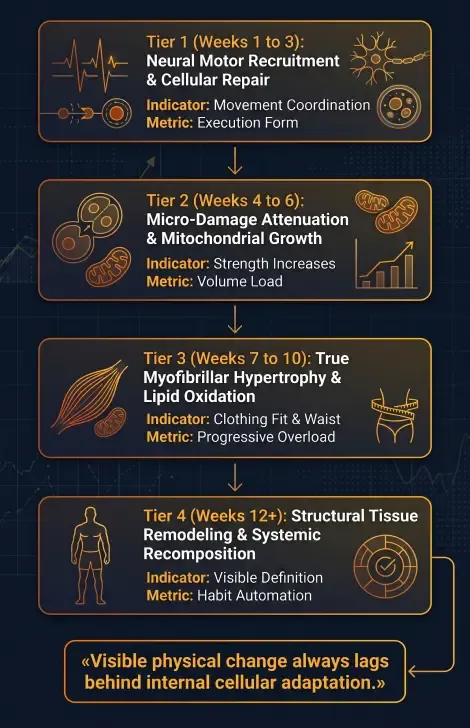
During the first four to six weeks of lifting, strength increases stem primarily from neuromuscular adaptations rather than muscle hypertrophy. Your central nervous system recruits high-threshold motor units more efficiently, increases firing rates, and improves coordination between muscle groups. While your muscles may not look larger yet, your neuromuscular capacity is expanding rapidly.
Furthermore, research on skeletal muscle plasticity by Damas and colleagues (
Damas et al., 2016) revealed that during early training phases, elevated myofibrillar protein synthesis is directed toward repairing micro-damage and cellular remodeling rather than expanding muscle cross-sectional area. True muscle hypertrophy correlates with protein synthesis only after initial muscle damage is attenuated. In short, your body must reinforce its cellular architecture before constructing visible muscle tissue.
Simultaneously, fluid dynamics often conceal fat loss on the scale. Local muscular inflammation from new training causes tissues to retain water for repair. In addition, each gram of stored muscular glycogen binds three to four grams of water. You can lose a pound of adipose tissue while retaining compensatory fluid, keeping scale weight temporarily flat.
| Training Phase | Internal Biological Mechanism | Observable Physical Indicator | Primary Progress Metric |
|---|
| Weeks 1 to 3 | Neural motor unit recruitment, micro-damage repair | Improved movement coordination, transient fluid retention | Exercise execution form and workout completion rate |
| Weeks 4 to 6 | Attenuation of muscle damage, mitochondrial biogenesis | Measurable strength progression, faster recovery | Training volume load and resting heart rate stability |
| Weeks 7 to 10 | True myofibrillar hypertrophy, progressive lipid oxidation | Clothes fitting looser, reduction in waist circumference | Caloric consistency and progressive overload log |
| Weeks 12+ | Systemic tissue remodeling, body recomposition | Visible muscle definition, favorable body composition shift | Habit automation and identity integration |
Shift from Outcome Fixation to Process-Driven Metrics
Clinging exclusively to outcome goals like losing twenty pounds or achieving a six-pack invites frustration during a plateau. Outcome goals lie outside your direct daily control, as they are susceptible to fluid shifts, hormonal fluctuations, and digestive variance. To stay motivated when progress slows, anchor your sense of success to controllable process metrics.
In a systematic review and meta-analysis on goal setting in active adults (
McEwan et al., 2024), researchers found that setting specific process goals exerts a large positive effect on physical activity adherence (effect size g = 1.11). Furthermore, interventions independent of external material rewards achieved significantly higher long-term adherence, proving that internal behavioral accountability outperforms superficial reward systems.
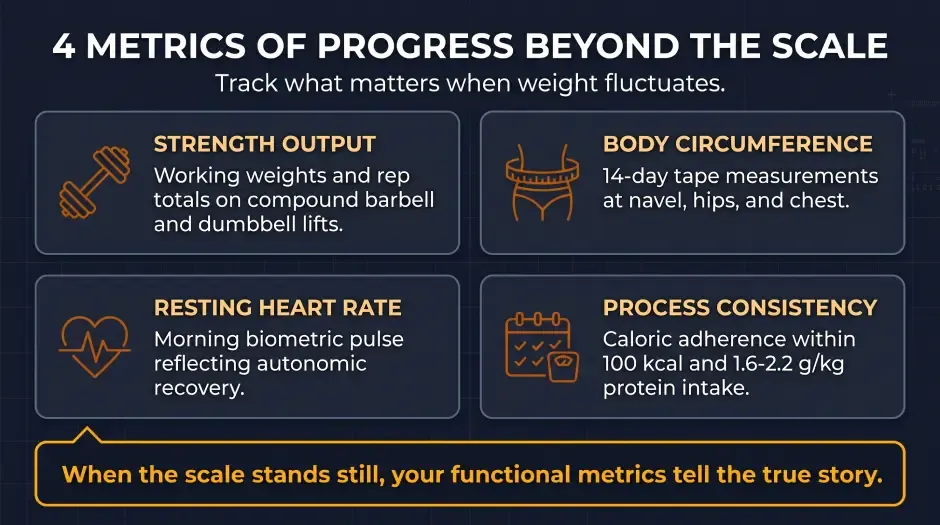
Replace daily weigh-ins with a scorecard of controllable execution habits:
- Caloric and Nutrient Consistency: Hit your daily caloric target within 100 calories and consume 1.6 to 2.2 grams of protein per kilogram of body weight. Use the FitWay Daily Calorie & TDEE Calculator to verify that your deficit is moderate rather than metabolically counterproductive.
- Progressive Resistance Volume: Log the exact weights, sets, and repetitions for every exercise session.
- Recovery Monitoring: Secure seven to nine hours of quality sleep nightly to support hormonal balance and tissue recovery.
- Target Range Context: Evaluate your healthy weight parameters with the FitWay Ideal Weight Calculator to maintain grounded expectations.
5 Practical Strategies to Reignite Momentum During a Plateau
When progress feels stalled, passive waiting leads to dropout. Use these five practical strategies to sustain momentum and maintain training discipline:
1. Maintain a Dedicated Non-Scale Victory Journal
The scale measures total mass, including water, food volume, and glycogen. Track functional non-scale victories instead: joint comfort, stamina, energy levels, and how your clothes fit. Building strength through a structured
Full Body Strength Routine delivers clear, verifiable performance metrics that prove your training stimulus is working.
2. Enforce the Two-Day Rule
Motivation fluctuates, but rules preserve habits. The Two-Day Rule dictates that you never permit two consecutive days of unplanned inactivity. If time constraints derail a full gym session, complete a quick 20-minute
beginner bodyweight workout at home to keep the psychological habit loop intact.
3. Conduct an Honest Seven-Day Nutritional Audit
Apparent plateaus often trace back to caloric creep: unmeasured cooking oils, sauces, liquid calories, and weekend surplus. Weigh your food on a digital scale for one week to recalibrate your portion estimates and restore an accurate deficit.
4. Rotate Accessory Exercises to Re-Engage Neural Drive
Keep your primary compound lifts constant to track progressive overload, but cycle secondary accessory exercises every four to six weeks. Swapping flat dumbbell presses for incline presses or alternating grip widths provides novel motor learning that stimulates dopamine without disrupting progression.
5. Anchor Your Habit to Identity Rather Than Emotion
Research shows that individuals who anchor exercise to personal identity sustain habits far better than those viewing workouts as chores. Reframe your mindset from 'I need to exercise' to 'I am someone who prioritizes health and strength.' Read more psychological strategies in the
Motivation blog hub to cultivate durable mental resilience.
Troubleshooting Stalled Progress: How to Diagnose the Cause
When slow progress persists beyond four to six weeks with zero change in strength or body measurements, run this targeted audit to identify the constraint:
- Audit Energy Balance: If weight is unchanged across four weeks, you are at maintenance calories. Metabolic adaptation and reduced spontaneous movement naturally lower energy expenditure over time. Decrease daily intake by 150 calories or increase your daily step target by 2,000 steps.
- Assess Systemic Fatigue: If lifting numbers are regressing and sleep quality is poor, accumulated fatigue may be masking your fitness gains. Take a scheduled one-week deload by reducing training volume by 50% while maintaining intensity to clear fatigue.
- Check Protein Spacing: Distribute total protein across three to four daily meals containing 25 to 40 grams of protein to trigger muscle protein synthesis consistently throughout the day.
Conclusion
Slow progress is an inevitable phase of every genuine fitness journey, not a sign of failure. Real physiological adaptations, including fat oxidation, muscle protein synthesis, and neuromuscular remodeling, require months of persistent stimulus. When your progress feels stagnant, remember that internal biological adaptations occur long before visible changes appear in the mirror.
Do not let fluctuating emotions dictate your fitness commitment. Anchor your routine to daily process targets, log non-scale victories, and trust the compounding nature of consistent training. Select your structured program, dial in your nutrition, and embrace the daily process with unwavering discipline.
Frequently Asked Questions
How long does it typically take to see visible fitness results?
Most healthy individuals begin noticing subtle physical changes, such as clothes fitting looser around the waist or improved muscular firmness, within six to eight weeks of consistent training and disciplined nutrition. Distinct, noticeable visual changes generally require ten to twelve weeks of adherence. During the initial four weeks, adaptations occur predominantly at the cellular, mitochondrial, and neuromuscular levels, establishing the functional structural foundation necessary for later visible aesthetic changes.
Why does body weight stay unchanged when exercising in a calorie deficit?
Scale weight is heavily influenced by fluid retention, glycogen storage fluctuations, and digestive contents rather than fat loss alone. Starting a new resistance or cardio routine causes localized micro-damage and inflammation in muscle tissues, prompting temporary water retention for cellular repair. Additionally, elevated cortisol from lifestyle stress, lack of sleep, or higher sodium intake can cause your body to hold several pounds of fluid, concealing true fat loss on the scale for several consecutive weeks.
What should I do when I completely lose motivation to workout?
When emotional motivation disappears, reduce your training friction and lean on disciplined behavioral habits. Lower the barrier to entry by committing to just ten minutes of light movement or completing a brief bodyweight routine at home. Taking the first physical action often triggers the neuromuscular arousal required to complete the workout. If profound exhaustion, poor sleep, and strength declines accompany your lack of motivation, take a structured four-day deload to allow your nervous system and muscles to recover fully.