Most people set fitness goals the wrong way. They pick a number (lose 20 lbs, bench 100 kg, run a 5K) and then wonder why they abandon it within six weeks. The problem is not lack of discipline. It is that the goal structure itself is working against them. Exercise psychology has spent decades studying what makes goals effective, and the findings are specific, actionable, and quite different from the generic advice that circulates online. This guide covers the science of goal setting for fitness, what types of goals actually drive behavior change, and how to build a goal structure that holds up when motivation dips.
Why Most Fitness Goals Fail Before They Start
A
2004 systematic review by Shilts, Horowitz, and Townsend published in the American Journal of Health Promotion analyzed 28 peer-reviewed studies on goal setting for physical activity and dietary behavior change. The review found that while goal setting showed promise for promoting behavior change in adults, the effectiveness depended heavily on the characteristics of how goals were set, not just whether goals were set at all.
The most consistent finding: vague goals produce vague results. "Get fit", "exercise more", and "lose some weight" are intentions, not goals. They provide no measurable standard to work toward, no clear point of success, and no feedback loop to tell you whether you are on track.
But specificity alone is not enough. A second and more recent problem was identified by a
2023 narrative review published in Health Psychology Review by Swann et al., which critically examined SMART goal frameworks for physical activity promotion. Their analysis found that rigid performance-focused goals (e.g., "run 5 km in under 25 minutes by March 1st") can actually be detrimental for beginners and inactive individuals, because failing to hit a fixed performance target early in the process undermines self-efficacy and leads to dropout. For people new to training, process and learning goals outperform performance goals in both adherence and long-term behavior change.
The implication: goal design needs to match where you are in your fitness journey, not just how ambitious you are.
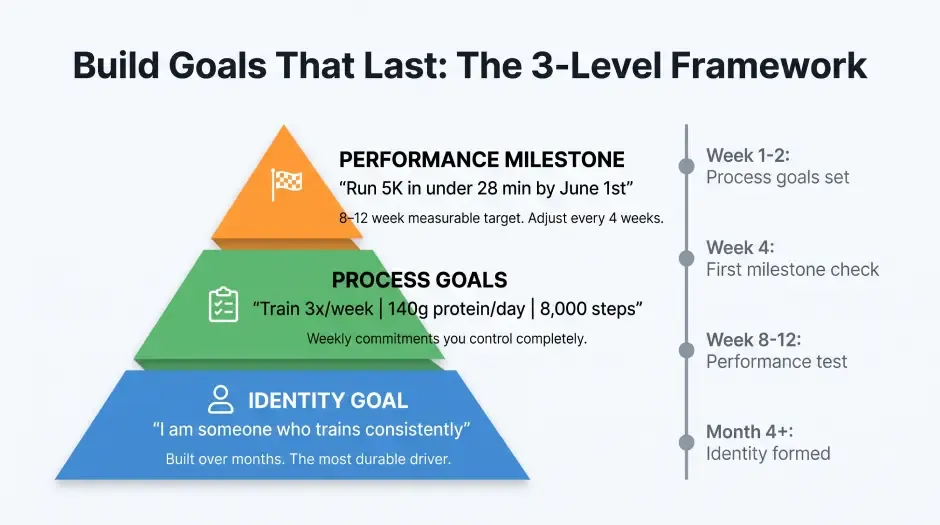
Exercise psychology distinguishes three types of goals, each with different strengths at different stages:
Performance goals define an outcome you want to achieve: run 5 km, lose 10 kg, deadlift 150 kg. These work well for experienced trainees who already have the skills and habits to pursue them without additional support. They are poor entry points for beginners because the gap between current ability and the target is large enough to be discouraging, and early failure is common.
Process goals define behaviors rather than outcomes: train three times per week, hit 8,000 steps daily, eat 150g of protein. These are more directly controllable and generate consistent feedback, making them better predictors of adherence for people in the early stages of change. Meeting a process goal provides positive reinforcement regardless of whether the performance goal has been reached yet.
Identity goals are the most durable but slowest to build: "I am someone who trains consistently", "I am an active person". Research rooted in Self-Determination Theory shows that when exercise becomes part of someone's identity rather than a means to an external end, long-term adherence becomes self-sustaining. Identity goals are not set as a starting point but cultivated deliberately over months of consistent process goal achievement.
A goal structure that works across time layers all three:
| Goal Type | Example | Best Stage | Adherence Driver |
|---|
| Identity | "I'm someone who trains regularly" | Long-term | Intrinsic, self-sustaining |
| Process | "Train 3x/week, hit protein targets" | Early to mid | Behavior control, daily wins |
| Performance | "Run 5K in under 28 min by June" | Mid to advanced | Measurable challenge |
The Goal Difficulty Problem: Challenge vs Achievability
Goal-setting theory, developed by Locke and Latham and extensively applied to physical activity, holds that specific and difficult goals lead to higher performance than vague or easy goals, as long as the person is capable of achieving them and commits to the goal.
A
2020 N-of-1 digital intervention study on goal difficulty and physical activity published in Annals of Behavioral Medicine tested this directly: on days when participants set higher step goals, they walked more, but they also achieved their goal less often. The tradeoff between ambition and achievability is real, and it plays out over time: consistently failing to hit a goal erodes motivation and self-efficacy even when behavior is genuinely improving.
The practical implication is a two-goal structure:
- Minimum goal: the floor you will always clear, even on bad days. For training, this might be: "I will complete at least 20 minutes of any physical activity on my scheduled training days." This protects the habit loop on low-energy days.
- Target goal: the full session you aim for under normal conditions. "I will complete my full body strength training session on Monday, Wednesday, and Friday."
On hard days, hitting the minimum keeps the streak intact. On normal days, the target drives performance. This structure prevents the all-or-nothing thinking that kills most fitness routines.
How to Build a Goal Hierarchy That Holds
Rather than setting one big goal, build a layered hierarchy with three levels:
Level 1 - Identity statement (long-term anchor):
Write one sentence about the person you are becoming, not the outcome you want. "I am building a body that supports a long, active life." This gives every training session meaning beyond the session itself.
Level 2 - Process goals (weekly commitments):
Define the specific behaviors you will perform this week. These are your implementation intentions. "On Monday, Wednesday, and Friday at 7am, I will train for 45 minutes." "Each day I will hit 140g of protein and 8,000 steps."
For beginners, the
beginner strength training foundation program or a
beginner HIIT workout at home makes the process goal concrete immediately: you are not deciding what to do each day, you are following a specific session.
Level 3 - Performance milestones (8-12 week targets):
Set one or two measurable outcomes you expect to achieve in the next 8-12 weeks. Keep them realistic for your starting point. "I will complete all scheduled sessions for 8 weeks." "I will increase my squat by 10 kg." "I will run 3 km without stopping."
Review Level 3 every 4 weeks and adjust if needed. A goal that no longer challenges you needs to be raised. A goal you are consistently failing despite genuine effort needs to be lowered or restructured as a process goal.
Approach Goals vs Avoidance Goals
A consistent finding in goal-setting research is the difference between approach goals and avoidance goals:
- Approach goals: move toward something positive. "I want to feel stronger and more energetic."
- Avoidance goals: move away from something negative. "I want to stop being out of breath on stairs." "I need to lose this belly fat."
Avoidance goals produce initial motivation but are psychologically exhausting over time. They keep attention on the problem rather than the progress, and as the negative state recedes, so does the motivational fuel. Research consistently shows that approach goals predict better long-term adherence.
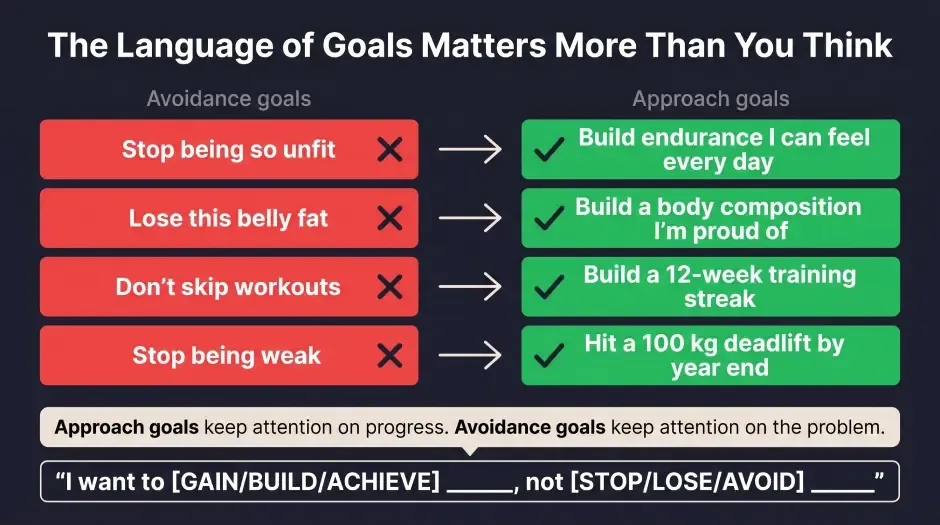
Reframe every avoidance goal as an approach equivalent:
| Avoidance Goal | Approach Equivalent |
|---|
| "Stop being so unfit" | "Build cardiovascular endurance I can feel" |
| "Lose this belly fat" | "Build a body composition I'm proud of" |
| "Stop being weak" | "Hit a 100 kg deadlift by end of year" |
| "Don't skip workouts" | "Build a training streak of 12 consistent weeks" |
Tracking Progress: The Feedback Loop Goals Require
Goal-setting theory identifies feedback as a required moderator of goal effectiveness. A goal without a feedback mechanism is a wish. You need to know whether you are on track often enough to adjust before you fall too far off.
For fitness goals, this means:
- Weekly: log every session (date, workout, key lifts or metrics). A simple note or app entry takes two minutes and closes the feedback loop.
- Monthly: compare process goal completion rate. Did you hit your scheduled sessions? Your protein targets? Your step counts? Completion rate below 70% signals the goal needs adjustment, not more willpower.
- Every 8-12 weeks: test against your performance milestone. Run your 3K, test your squat, check your body composition. This is not about judgment. It is data for the next goal cycle.
For structured training programs, FitWay provides built-in tracking. If you are doing a
beginner functional HIIT workout for fat loss or an
intermediate bodyweight toning program, logging each session creates the feedback loop that keeps the goal structure working over time.
Conclusion
Fitness goals that work are not bigger or more motivating than the ones that fail. They are better designed. Start with a process goal and an implementation intention. Add one performance milestone for 8-12 weeks out. Frame everything as an approach goal. Build in a weekly feedback loop. And underneath all of it, start building the identity statement that makes training something you do rather than something you are trying to do. The science is clear: goal structure predicts adherence more reliably than goal ambition. Design your goals the right way, and showing up becomes the default.
Frequently Asked Questions
How many fitness goals should I set at once?
Research on goal setting consistently finds that setting too many goals simultaneously reduces commitment to each one. For most people, one to two process goals and one performance milestone is the effective range. A practical structure: one process goal for training frequency ("train three times per week"), one for nutrition ("hit 140g of protein daily"), and one 8-12 week performance milestone ("complete 8 consecutive weeks of scheduled training"). Adding more goals before these are established divides attention and reduces the likelihood of achieving any of them. Consolidate first, then expand once the initial habits are stable.
Should my fitness goals be public or private?
The research here is more nuanced than popular advice suggests. Public commitment increases social accountability, which can boost adherence in the short term. However, some research suggests that publicly announcing a goal can create a premature sense of achievement that reduces the internal drive to actually pursue it. A middle path works best for most people: share your process goals with one or two people who will hold you accountable (a training partner, a coach, a close friend) rather than broadcasting performance goals on social media. Accountability with specificity beats public declaration without it.
What should I do when I fail to hit my fitness goals?
First, distinguish between failing a process goal (you did not do what you planned) and failing a performance goal (you did the work but did not hit the number). These require different responses. For missed process goals, the only relevant question is: what made showing up harder than it needed to be? Remove that friction before the next session. Reduce the minimum goal if needed. For performance goals you did not reach despite consistent effort, the goal was likely set too aggressively for your current stage. Restructure it as a process goal or extend the timeline. Missing a goal is data about goal design, not evidence about your potential.