Balancing volume, frequency, and recovery is the central challenge for intermediate lifters. Traditional body-part splits often leave muscles idle for nearly a week, while full-body routines can generate excessive systemic fatigue. The 4-day upper lower split solves this dilemma by dividing your physique across the hips into dedicated upper-body and lower-body training days. By stimulating every major muscle group twice weekly with manageable fatigue, this framework provides the ideal sweet spot for hypertrophy training and progressive strength gains.
Biomechanics and Structure of the Upper Lower Split
The upper lower split organizes your weekly training around kinetic synergy. Rather than isolating individual body parts across five or six workouts, your schedule divides into two distinct units:
- Upper Body Sessions: Target the chest, back, shoulders, biceps, and triceps through coordinated horizontal and vertical pushing and pulling mechanics.
- Lower Body Sessions: Target the quadriceps, hamstrings, gluteus maximus, calves, and core stabilizers through compound squats, hip hinges, and unilateral leg movements.
This separation offers a distinct physiological advantage: complete rest for the opposing kinetic chain. When performing heavy compound barbell gym lifts on upper body day, your lower back, hips, and knees rest completely. Conversely, when squatting and hinging on lower body day, your shoulder girdles and elbow flexors recover without stress.
Compared to a six-day Push Pull Legs routine, a 4-day split requires two fewer gym visits weekly while delivering an equivalent muscle-building stimulus. Trainees who need 48 to 72 hours between sessions to recover properly often achieve faster progress on four focused workouts than on six fatigued sessions.
The Exercise Science: Volume, Frequency, and Muscle Growth
Modern sports science confirms that muscle growth is governed by cumulative weekly volume and training frequency.
In a systematic review and meta-analysis in the Journal of Strength and Conditioning Research (
Ramos-Campo et al., 2024), researchers evaluated 14 randomized trials comparing split routines to full-body training. When weekly volume was equated, split and full-body routines produced similar gains in strength and muscle thickness, proving muscle tissue responds primarily to cumulative weekly tension.
However, frequency influences workout quality. A meta-analysis in Sports Medicine (
Schoenfeld et al., 2016) showed that training a muscle group twice weekly induces superior hypertrophy compared to once weekly under volume-equated conditions. Training a muscle twice every seven days elevates muscle protein synthesis twice, preventing anabolic lulls between workouts.
Furthermore, a dose-response review in the Journal of Human Kinetics (
Baz-Valle et al., 2022) established that moderate weekly volumes of 12 to 20 sets per muscle group optimize muscle hypertrophy for trained lifters, while volumes exceeding 20 sets yield diminishing returns.
The 4-day upper lower split divides this 12 to 20 set target cleanly: you perform 6 to 9 direct working sets per muscle group on Upper Day 1, and repeat that volume on Upper Day 2 with high energy and sharp technique.
4-Day Upper Lower Split Schedule
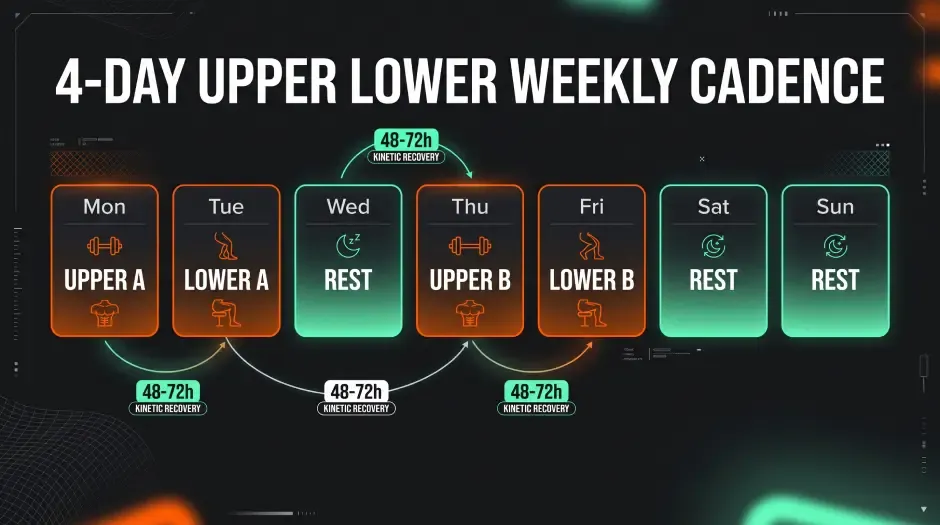
The standard upper lower split follows a 2-on, 1-off, 2-on, 2-off structure, ensuring each kinetic chain receives 48 to 72 hours of recovery.
| Day | Workout Session | Primary Movement Patterns | Focus |
|---|
| Monday | Upper Body A | Horizontal Press, Row & Vertical Pull | Strength & Tension |
| Tuesday | Lower Body A | Squat, Hamstring Curl & Calves | Quads & Knee Flexion |
| Wednesday | Rest Day | Walking & Joint Mobility | Systemic Recovery |
| Thursday | Upper Body B | Incline Press, Overhead Press & Pulldown | Hypertrophy & Pump |
| Friday | Lower Body B | Deadlift/RDL, Lunge & Calves | Posterior Chain & Glutes |
| Weekend | Rest Days | Light Mobility & Sleep | Full Tissue Repair |
Lifters with irregular schedules can use a rolling format: Upper, Lower, Rest, Upper, Lower, Rest, Repeat. This cadence completes five workouts every nine days, accommodating busy lifestyles.
The 4-Day Master Workout Routine
This blueprint alternates between "A" and "B" workouts to blend heavy compound lifting with targeted isolation work. Session A emphasizes horizontal mechanics and foundational strength, while Session B stresses incline angles, vertical pathways, and metabolic fatigue.
| Day & Session | Exercise Selection | Sets x Reps | Rest | Target RIR |
|---|
| Upper A | Barbell Bench Press | 4 x 6-8 | 3 min | 1-2 RIR |
| Chest-Supported Row | 4 x 6-8 | 2 min | 1-2 RIR |
| Overhead Press | 3 x 8-10 | 2 min | 1-2 RIR |
| Lat Pulldown | 3 x 10-12 | 90s | 1 RIR |
| Incline Dumbbell Curl | 3 x 10-12 | 75s | 0-1 RIR |
| Cable Triceps Extension | 3 x 10-12 | 75s | 0-1 RIR |
| Lower A | Barbell Back Squat | 4 x 6-8 | 3 min | 1-2 RIR |
| Romanian Deadlift | 3 x 8-10 | 2 min | 2 RIR |
| Leg Press | 3 x 10-12 | 90s | 1 RIR |
| Seated Leg Curl | 3 x 12-15 | 75s | 0-1 RIR |
| Standing Calf Raise | 4 x 12-15 | 60s | 0 RIR |
| Upper B | Incline Barbell Press | 4 x 8-10 | 2 min | 1-2 RIR |
| Neutral Pulldown | 4 x 8-10 | 2 min | 1-2 RIR |
| Dumbbell Shoulder Press | 3 x 10-12 | 90s | 1 RIR |
| Dumbbell Row | 3 x 10-12 | 90s | 1 RIR |
| Cable Lateral Raise | 4 x 12-15 | 60s | 0-1 RIR |
| Skull Crusher | 3 x 10-12 | 75s | 0-1 RIR |
| Lower B | Trap Bar Deadlift | 3 x 5 | 3 min | 2 RIR |
| Bulgarian Split Squat | 3 x 8-10 / leg | 90s | 1 RIR |
| Leg Extension Machine | 3 x 12-15 | 75s | 0-1 RIR |
| Lying Hamstring Curl | 3 x 10-12 | 75s | 0-1 RIR |
| Seated Calf Raise | 4 x 15-20 | 60s | 0 RIR |
Before loading top sets on foundational compound lifts, use the
FitWay One-Rep Max Calculator to determine precise working weights between 72% and 82% of your 1RM.
If you want an intensive lower-body session focused strictly on quad, glute, and hamstring development, incorporate our dedicated
Intermediate Lower Body Hypertrophy routine into your program.
Progressive Overload and Fatigue Management
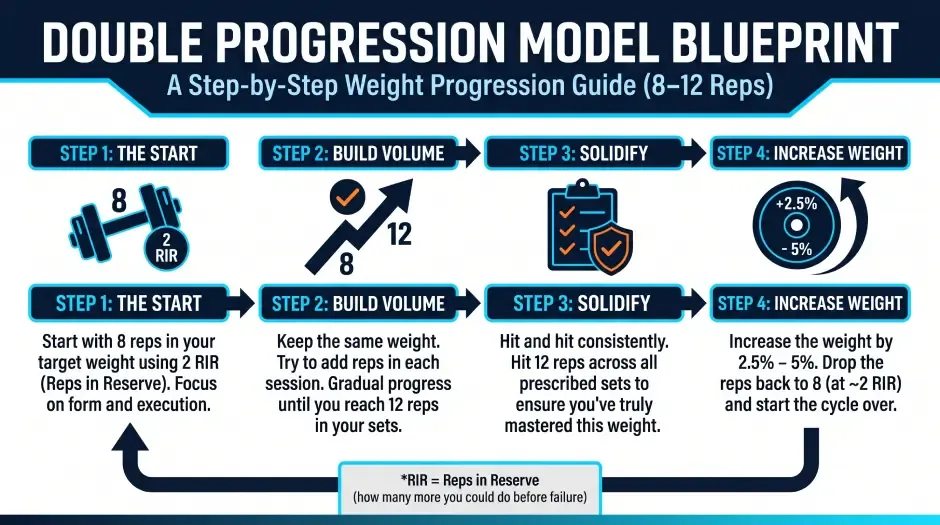
A training split only produces results when paired with consistent progressive overload. Use the Double Progression Model on accessory lifts:
- Set a Target Range: Pick a repetition bracket (for example, 8 to 12 reps).
- Hold Weight Constant: Select a load where you achieve 8 repetitions with 2 Repetitions in Reserve (RIR).
- Add Repetitions: In subsequent workouts, push toward 12 repetitions on all sets with strict form.
- Increase Weight: Once you achieve 12 reps across all sets, increase resistance by 2.5% to 5% and reset to 8 repetitions.
For primary compound barbell lifts, progress via micro-loading: add 1 to 2.5 kg weekly while maintaining sets and repetitions.
Managing Spinal Fatigue and Deloading
The upper lower split demands careful management of axial loading. Squatting on Tuesday followed by deadlifting on Friday places substantial demands on spinal stabilizers. Maintain at least 48 hours between Lower A and Lower B, and use chest-supported rows to give your lumbar spine adequate rest.
Schedule a deload week every 6 to 8 weeks. Cut your total working sets by 50%, reduce load by 10%, and stay 3 to 4 reps short of failure. Deloads allow connective tissue to remodel, restore energy reserves, and prevent overreaching. Lifters seeking broader periodization principles can consult our
Training blog hub and our
Muscle Building insights.
Nutritional Protocols for Muscle and Strength
Training supplies the growth stimulus, but nutrition provides the raw materials for tissue synthesis.
To build muscle without excessive fat accumulation, maintain a conservative caloric surplus of 200 to 300 calories above maintenance. Calculate your baseline requirements using the
FitWay Daily Calorie & TDEE Calculator.
Follow these evidence-based nutritional guidelines:
- Protein Intake: Consume 1.6 to 2.2 grams per kilogram of body weight daily (0.73 to 1.0 g/lb), divided across 3 to 5 meals.
- Carbohydrates: Ingest 3.5 to 5.0 grams per kilogram daily to maintain glycogen stores and sustain lifting performance.
- Dietary Fats: Keep fats between 0.6 and 1.0 grams per kilogram daily (20% to 30% of total calories) to support hormonal health.
Calculate your exact macro split with the
FitWay Macro Splitter Calculator. Pair this nutrition with 3 to 5 grams of daily creatine monohydrate and 7 to 9 hours of quality sleep to maximize recovery.
Conclusion
The 4-day upper lower split represents one of the most effective, science-backed workout architectures for natural lifters. By organizing workouts into two upper and two lower sessions, you satisfy the proven twice-weekly frequency benchmark while leaving three full rest days for recuperation and growth.
Commit to the schedule, track your lifts in a logbook, apply progressive overload systematically, and fuel your training with adequate calories and protein. Consistent effort within this framework will deliver reliable gains in both muscular size and raw strength.
Frequently Asked Questions
Is a 4-day upper lower split better than a 6-day Push Pull Legs routine?
Neither routine is universally better, but a 4-day upper lower split is far more manageable for most lifters. A 6-day Push Pull Legs split leaves only one rest day weekly, demanding exceptional recovery and strict sleep. The 4-day upper lower split delivers equivalent weekly volume across four high-intensity sessions, leaving three full rest days for joint health, systemic recovery, and work-life balance.
Can you build strength and muscle simultaneously on an upper lower split?
Yes, the upper lower split is ideal for concurrent strength and hypertrophy. Each session begins with heavy compound barbell lifts performed for 5 to 8 reps with full rest (2 to 3 minutes) to maximize neural drive and mechanical tension. You then transition to accessory dumbbell and cable exercises for 8 to 15 reps to generate metabolic stress, building muscular size while systematically increasing foundational strength.
How should beginners adjust the 4-day upper lower split routine?
Beginners transitioning from introductory programs should reduce total session volume during their first month. Start with two working sets per exercise instead of three or four, keeping two to three Repetitions in Reserve (RIR) to master mechanics safely. In addition, select stable variations, such as leg presses before heavy barbell squats and lat pulldowns before weighted pull-ups.