Building muscle after 40 is not only possible, it is one of the highest-return health investments you can make. Muscle mass protects against metabolic disease, maintains functional independence, and directly correlates with longevity. The challenge is that the physiological rules shift with age: hormonal output declines, recovery slows, and muscle tissue becomes less responsive to the same stimuli that worked in your 20s. The good news is that these changes are well-understood, and the training and nutrition adjustments required are specific and manageable. This guide covers exactly what changes after 40 and what to do about it.
What Changes in Muscle Physiology After 40
Sarcopenia, the age-related loss of muscle mass, begins as early as the mid-30s and accelerates after 60. Without intervention, adults lose approximately 3-8% of muscle mass per decade after 30, with the rate increasing significantly after 60. Three physiological changes drive this process:
Anabolic hormone decline: testosterone in men drops approximately 1% per year after 30. Growth hormone output decreases by 14-15% per decade. These hormones directly regulate muscle protein synthesis and recovery speed.
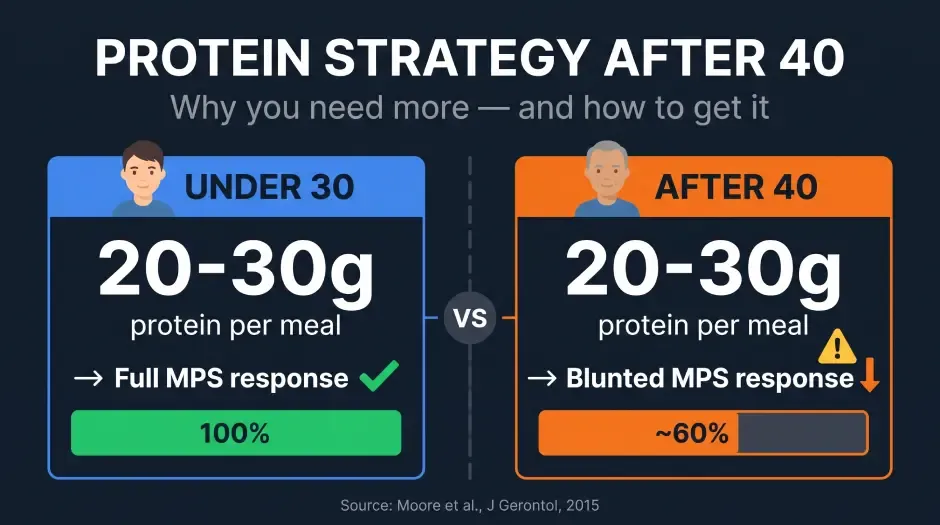
Anabolic resistance: older muscle tissue becomes less responsive to protein intake. The same meal that maximally stimulates muscle protein synthesis (MPS) in a 25-year-old produces a blunted response in a 50-year-old. A landmark
study by Moore et al. published in the Journal of Gerontology demonstrated that older men require significantly greater relative protein intake per meal to achieve the same MPS response as younger men, confirming that anabolic resistance is a real and quantifiable phenomenon, not a myth.
Slower recovery: reduced satellite cell activity and altered inflammatory response after exercise means that the recovery window between hard sessions extends. What took 48 hours to recover from at 25 may take 72-96 hours at 50.
None of these changes make muscle building impossible. They make the margin for programming error smaller and the importance of precision higher.
Training Principles for Building Muscle After 40
The fundamental drivers of hypertrophy, mechanical tension, progressive overload, and training volume, remain the same at any age. What changes is how to apply them safely and sustainably.
Lower frequency, higher quality: training each muscle group 2 times per week remains the evidence-based minimum for hypertrophy at any age. However, the volume per session should be more conservative than in younger years, with recovery quality determining whether to push toward the upper end of the volume range.
Rep range flexibility is an advantage: a
2020 meta-analysis on resistance training and muscle fiber hypertrophy in older adults found that resistance training consistently induces cellular hypertrophy in older adults, though the effect is attenuated with very high training intensities. This supports a practical strategy of working across a broader rep range (8-20 reps per set) with moderate loads rather than pushing maximum intensity on every session, which reduces joint stress while maintaining the hypertrophic stimulus.
Compound movements remain the foundation: squats, deadlifts, rows, and presses recruit the largest muscle mass and produce the strongest hormonal response. A
full body strength program built around compound barbell and dumbbell lifts covers the essential movement patterns and provides a scalable progressive overload framework. For those newer to structured lifting,
beginner strength training at the gym builds the technique base first.
Extend rest periods: rest 2-3 minutes between compound sets. Shorter rest periods increase fatigue accumulation and compromise the ability to maintain load across sets, which limits the mechanical tension stimulus.
Prioritize the eccentric phase: controlled lowering (3-4 second eccentric) increases mechanical tension without requiring heavier loads. This is particularly useful when joint sensitivity limits maximum loading.
| Training Variable | Under 30 | After 40 |
|---|
| Sessions per week | 4-6 | 3-4 |
| Sets per muscle/week | 15-20 | 10-15 |
| Rep range | 6-15 | 8-20 |
| Rest between sets | 60-120 sec | 90-180 sec |
| Recovery between sessions | 48 hrs | 72-96 hrs |
| Deload frequency | Every 6-8 weeks | Every 4-6 weeks |
Nutrition: Where Most People Over 40 Fall Short
Diet is where most people over 40 undermine their training results without realizing it. Two adjustments produce the majority of the benefit:
Increase protein significantly: due to anabolic resistance, the protein intake required to maximize MPS per meal is higher after 40. Current evidence supports a target of 0.9-1.2g of protein per pound of body weight per day (2-2.4g per kg) for adults over 40 who train regularly. This is 20-30% higher than standard recommendations for younger adults.
Distribute protein across 4 meals rather than 3, with a minimum of 40-50g of protein per meal. The Moore et al. research showed that smaller protein doses that adequately stimulate MPS in younger adults fail to reach the threshold in older adults. Spreading higher doses across more meals addresses this directly.
Top protein sources for this goal:
| Food | Serving | Protein (g) |
|---|
| Chicken breast | 200g | 60g |
| Salmon | 200g | 50g |
| Cottage cheese | 250g | 28g |
| Greek yogurt | 200g | 20g |
| Eggs | 3 large | 18g |
| Whey protein | 1 scoop (35g) | 25-30g |
Pre-sleep protein: casein protein or cottage cheese (30-40g of protein) before bed extends muscle protein synthesis through the overnight fasting window. This intervention has consistent research support and is particularly relevant for older adults where the overnight period represents a larger proportion of daily muscle protein breakdown.
Calorie strategy: avoid extended calorie deficits. Prolonged restriction suppresses anabolic hormones that are already declining with age. If fat loss is a concurrent goal, limit the deficit to 200-300 calories per day and keep protein at the high end of the range. Aggressive cutting after 40 almost always results in significant muscle loss alongside fat loss.
Recovery: The Most Undervalued Variable After 40
Recovery capacity decreases with age, making it the variable that most often limits progress for older trainees. Three levers have the largest impact:
Sleep: growth hormone is released almost exclusively during slow-wave sleep. Research consistently links sleep duration of less than 7 hours with accelerated muscle loss and impaired recovery in older adults. Target 7-9 hours with a consistent schedule.
Deload weeks: plan a deload every 4-6 weeks during structured training blocks. Reduce volume by 40-50% while maintaining load. This clears accumulated fatigue and allows supercompensation to express itself fully. Skipping deloads after 40 is the most common reason for stalled progress and overuse injuries.
Active recovery: light movement on rest days, walking, swimming, or a
beginner flexibility and mobility routine, improves blood flow and reduces stiffness without adding training load. Mobility work also directly addresses the joint range of motion limitations that accumulate with age and restrict exercise quality.
Supplements Worth Considering After 40
Three supplements have the clearest evidence for supporting muscle building specifically in older adults:
- Creatine monohydrate: 3-5g daily. Multiple studies show creatine has stronger relative benefits in older adults than younger adults, improving both strength and muscle mass when combined with resistance training.
- Vitamin D3: 2,000-4,000 IU daily. Deficiency is widespread in adults over 40 and directly impairs testosterone production and muscle protein synthesis. Aim for serum 25(OH)D of 40-60 ng/mL.
- Omega-3 (EPA+DHA): 2,000-3,000 mg daily. Reduces exercise-induced inflammation, supports recovery, and has direct evidence for enhancing MPS response to protein in older adults.
Conclusion
Building muscle after 40 requires more precision than in younger years, but not more complexity. Increase protein to 0.9-1.2g per pound of body weight, train each muscle group twice per week with compound movements, allow adequate recovery between sessions, plan regular deloads, and protect sleep quality. These adjustments directly address the physiological shifts that occur with age. Start with a manageable 3-day training structure, build consistency over 8-12 weeks, and adjust from there. The capacity to build meaningful muscle after 40 is well-supported by research and largely a matter of applying the right principles consistently.
Frequently Asked Questions
Can you build as much muscle after 40 as you could in your 20s?
The rate of muscle gain slows after 40, but the capacity to build muscle remains significant. Research shows that untrained adults over 40 who begin resistance training can gain 1-2 lbs of lean muscle per month in the first year, comparable to rates seen in younger beginners. The primary difference is that recovery takes longer, protein requirements are higher, and the margin for programming error is smaller. Advanced trainees over 40 build muscle more slowly than they did in their 20s, but sustained progress over 12-24 months produces substantial changes in body composition at any age.
How many days per week should you train after 40?
Three to four days per week is the optimal range for most adults over 40. This allows each muscle group to be trained twice weekly (the minimum effective frequency for hypertrophy) while providing 72-96 hours of recovery between sessions targeting the same muscles. A 3-day full-body program or a 4-day upper/lower split both work well. More than 4 hard sessions per week increases injury risk and recovery debt without proportionally increasing muscle growth stimulus in older trainees.
Is soreness a sign of a good workout after 40?
Soreness indicates muscle damage, which is one input to the hypertrophy process but not the most important one. After 40, excessive soreness is more likely a sign of too much volume or too high intensity rather than optimal stimulus. The most productive training sessions produce mild to moderate soreness that resolves within 48-72 hours. Chronic severe soreness, lasting more than 3 days, signals that recovery is not keeping pace with training load and volume needs to be reduced.