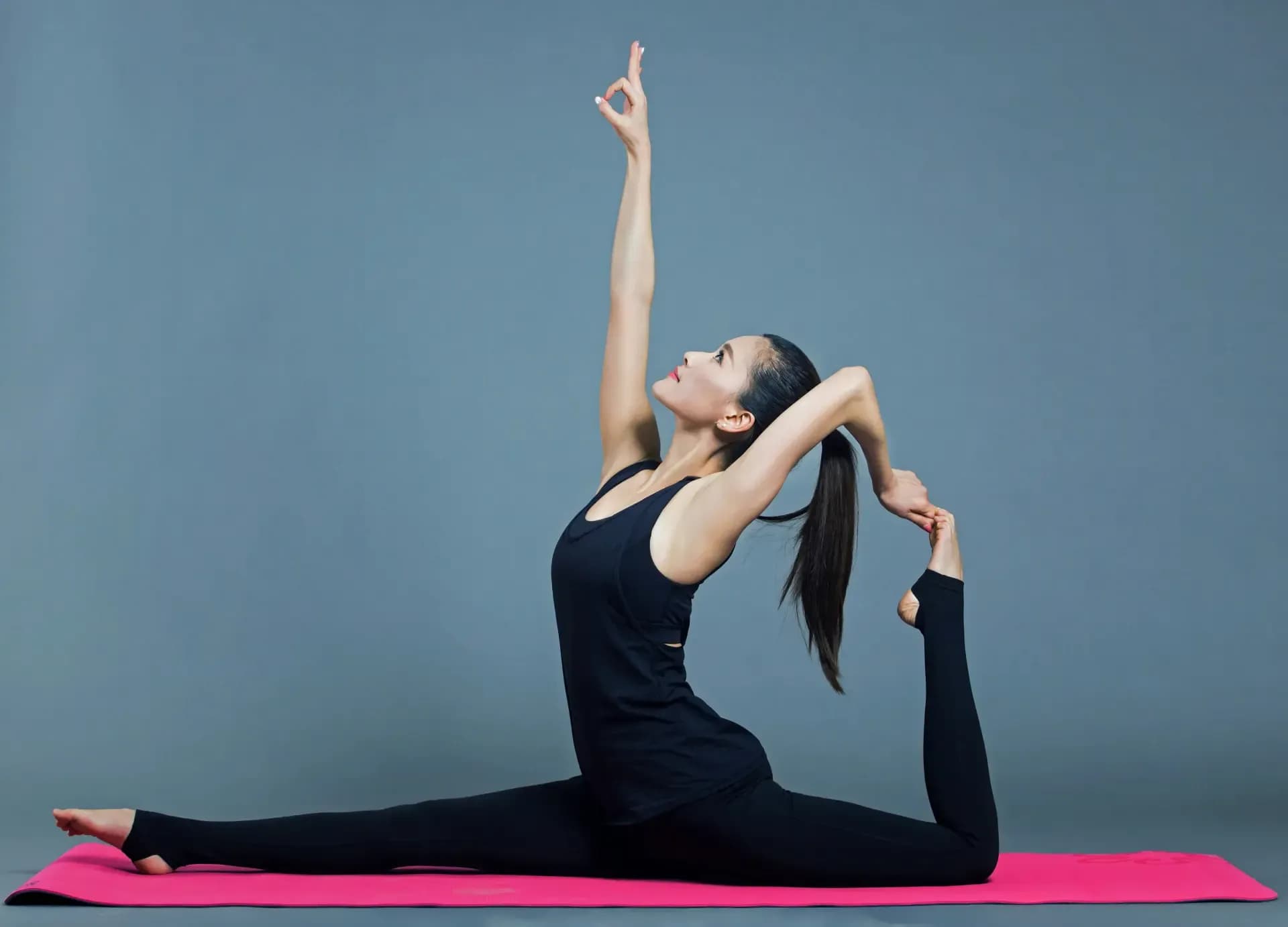
Beginner Flexibility & Mobility Routine: 8 Stretches at Home
A 30-minute beginner flexibility routine using a resistance band - eight guided stretches that improve range of motion, release chronic tension, and build the mobility foundation every active body needs. No prior flexibility required.
Exercise List (8)
Resistance Band Overhead Shoulder Stretch
2 Sets • 30 sec per side • 30s
No animation available
Form Preview
Execution Technique
"Hold the resistance band with both hands at shoulder width, arms straight out in front of you. Slowly raise the band overhead, keeping your arms straight, and continue in an arc behind your head until the band rests behind your hips — this is a shoulder pass-through. Widen your grip if you cannot complete the arc with straight arms; that is the correct starting width. Once you find the range where you feel a productive stretch in your chest, front shoulder, or biceps, stop and hold that position for 30 seconds. Breathe slowly — four counts in, six counts out — and allow the shoulders to open gradually on each exhale. Do not force the arc; let the band guide the movement. Return forward and repeat, narrowing your grip slightly each session as range of motion improves."
Pro Tips
This is a warm-up exercise for the shoulders and thoracic spine — perform it before deeper stretches. The resistance band is essential here because it gives you something to pull against, which helps the nervous system feel safe in the overhead position and allows greater range than a passive arm raise. The wider your grip, the easier the movement; narrow gradually as mobility improves.
Avoid
Bending the elbows to complete the arc when the grip is too narrow — always widen the grip instead of compromising arm position. Holding the breath during the hold rather than using slow exhalations to deepen the stretch. Rushing the pass-through as a dynamic movement rather than finding and holding the point of productive tension.
Thoracic Spine Rotation Stretch
2 Sets • 30 sec per side • 30s
Resistance Band Hip Flexor Stretch
2 Sets • 40 sec per side • 40s
Resistance Band Supine Hamstring Stretch
2 Sets • 40 sec per side • 40s
Figure Four Glute Stretch
2 Sets • 40 sec per side • 40s
Resistance Band Seated Adductor Stretch
2 Sets • 40 sec per side • 40s
Resistance Band Standing Calf Stretch
2 Sets • 30 sec per side • 30s
Child's Pose with Resistance Band Lat Reach
2 Sets • 40 sec • 40s
Flexibility training is the most consistently skipped component of fitness, and the most consistently regretted one. People notice its absence when they cannot touch their toes, when their hips ache after sitting, when their shoulders round forward at a desk, or when an injury sidelines them from a bodyweight strength program they actually enjoy. This program addresses all of that - systematically, progressively, and in 30 minutes.
This beginner routine uses a single resistance band to assist and deepen stretches that would otherwise require a partner or significant pre-existing flexibility. The band allows you to apply controlled, gradual tension to a muscle group without forcing the joint - a critical distinction for beginners who may be tempted to use momentum or bodyweight to push into a range of motion their tissues are not yet prepared for. Flexibility gains made through forced, ballistic stretching are short-lived and carry real injury risk. Gains made through sustained, controlled tension are structural and lasting.
Each stretch in this routine is held for 30–45 seconds per side. This duration is evidence-based: research consistently shows that static holds under 20 seconds produce minimal lasting change in muscle length, while holds of 30–60 seconds begin to create measurable and cumulative improvements in tissue extensibility over time. The nervous system - specifically the Golgi tendon organ response - needs roughly 20–30 seconds to relax its protective tension before the muscle can lengthen further. Work with this physiology, not against it.
The routine follows a logical top-to-bottom sequence: shoulders and thoracic spine first, then hip flexors, hamstrings, glutes, adductors, and finally the calves and ankle complex. This order is intentional - opening the upper body first improves your ability to maintain correct posture during lower-body stretches, and releasing hip flexors before hamstrings prevents the pelvis from tilting anteriorly and limiting your actual hamstring range.
Breathing is not optional in this program - it is the mechanism. Each exhale creates a small reduction in the nervous system's protective response to stretch, allowing the muscle to release slightly further. Inhale through the nose for four counts, exhale slowly through the mouth for six. On every exhale, allow yourself to sink gently deeper into the stretch - never force it, just allow. This technique alone will give you noticeably more range of motion within a single session compared to passive holding without breath focus.
Consistency produces results here more than intensity does. Three sessions per week over eight weeks will produce changes you can see and feel - pair this routine with rest days from a beginner strength program rather than skipping recovery work entirely. Daily sessions of even 15 minutes will produce them faster. The resistance band is the only equipment required - the same tool used in a resistance band toning routine if you want to build strength with the same minimal setup.
One note for beginners: the sensation of a productive stretch is distinct from pain. A stretch should feel like moderate pulling tension - a 5 or 6 out of 10 intensity - not sharp, hot, or pinching. If you feel any of those sensations, reduce the depth of the stretch immediately. Pain is the nervous system signaling tissue stress, not flexibility progress.
Expert Tips
- •Breathe deeply into each stretch; do not hold your breath.
- •Warm up your muscles with light cardio before static stretching.
- •Consistency is more important than intensity when stretching.
Common Mistakes
- ×Bouncing or forcing a stretch (ballistic stretching) which can cause injury.
- ×Stretching cold muscles.
- ×Ignoring asymmetrical tightness (stretching both sides equally even if one is tighter).
Reviews
Based on 0 reviews
Leave a Review
Recent Reviews
Loading reviews...
About the Author

Mike Chen
CSCS, CrossFit L2
Upgrade to Pro
Get unlimited access to all workout programs and expert nutrition plans.