Compound exercises form the bedrock of productive resistance training. When your goal is full-body muscle growth and functional power, multi-joint movements allow you to handle heavier loads across multiple joints simultaneously. Rather than isolating single muscles with machines, compound lifts recruit large networks of muscle groups, creating mechanical tension across dozens of working motor units in a single repetition. Selecting, executing, and programming these fundamental lifts will dictate the pace of your physique progress over months and years of training.
Biomechanics of compound movements: why multi-joint lifts drive growth
Multi-joint exercises produce a distinct neuromuscular stimulus compared to isolation movements. When you perform a squat or a barbell row, the nervous system coordinates prime movers, synergists, and stabilizing muscles to transfer force while maintaining balance. This pattern recruits high-threshold motor units that hold the greatest potential for muscle hypertrophy.
In an 8-week clinical trial published in Frontiers in Physiology (
Paoli et al., 2017), researchers compared multi-joint and single-joint programs under volume-equated conditions. While changes in whole-body lean mass were similar between groups, the multi-joint group produced significantly greater increases in maximal strength (1RM) and cardiorespiratory fitness ($VO_{2max}$). Multi-joint exercises permit higher absolute loads, exposing skeletal muscle to greater external resistance and mechanical work in less gym time.
A comprehensive review in Sports Medicine (
Gentil et al., 2017) evaluated adaptations between multi-joint and single-joint exercises. The authors found that multi-joint movements stimulate both primary and secondary muscles effectively, making isolation exercises unnecessary for general muscle growth in early and intermediate lifters. While single-joint exercises help address lagging muscles, heavy compound movements provide the primary stimulus that drives muscle protein synthesis across your body.
The seven primary compound lifts for complete muscular development
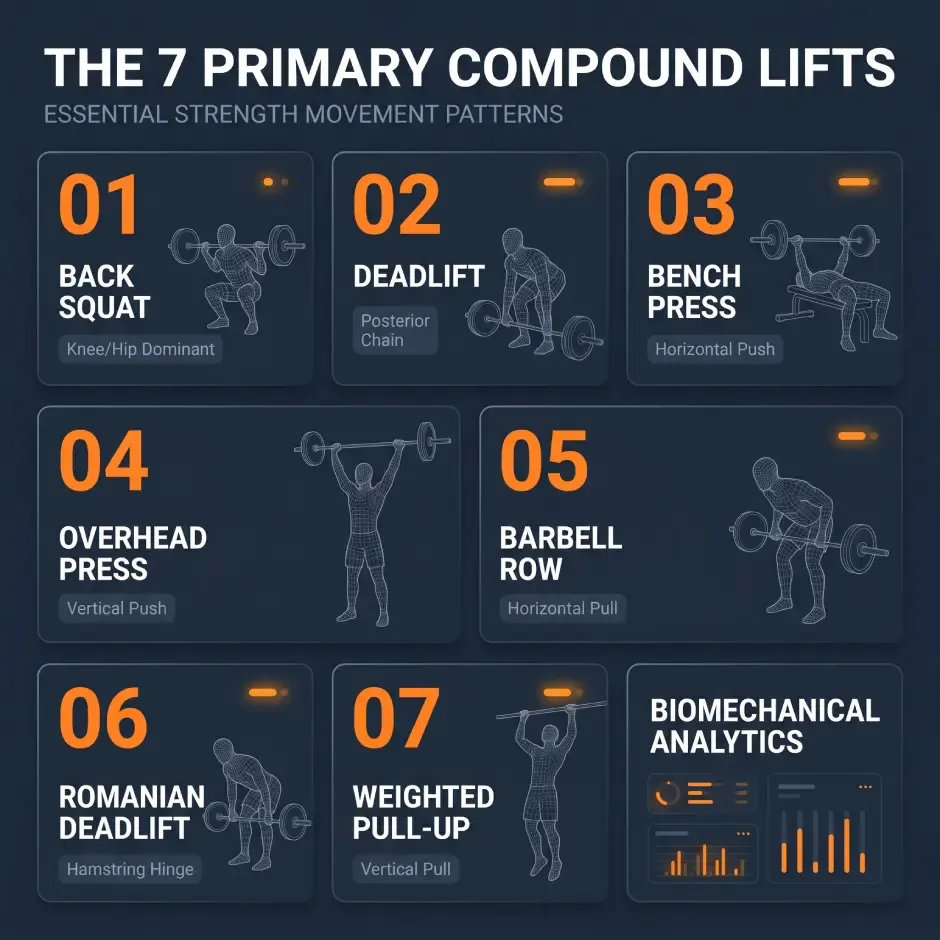
Structuring a balanced physique requires hitting the primary movement patterns: knee flexion and hip extension, horizontal pushing and pulling, vertical pushing and pulling, and hinge mechanics. These seven compound exercises cover every major muscle group from neck to calves.
1. Barbell back squat
The back squat is the benchmark for lower-body development. Placing a barbell across your upper traps or rear deltoids loads the entire kinetic chain. The descent demands eccentric control from the quadriceps, while the ascent requires concentric drive from the glutes, adductors, and quads. Spinal erectors and the abdominal wall work statically to keep your torso upright.
2. Conventional barbell deadlift
The conventional deadlift develops posterior chain power. Pulling a barbell from the floor demands forceful hip extension from the glutes and hamstrings, while your lats and upper back lock the bar close to your body. The lift builds spinal erector thickness that isolation work cannot match, training your body to generate force from a dead stop.
3. Flat barbell bench press
The flat bench press recruits the pectoralis major, anterior deltoids, and triceps brachii. Retracting your shoulder blades into the bench creates a stable foundation, allowing you to press heavy loads through a horizontal plane. A moderate grip width balances pectoral stretch with mechanical output from the triceps and shoulders.
4. Standing barbell overhead press
The standing overhead press challenges shoulder development while demanding total-body stabilization. Pressing a barbell from your collarbone to lockout activates the deltoids, upper pectorals, and triceps. Performing this movement standing forces your abdominal stabilizers and glutes to contract, preventing lumbar hyperextension.
5. Bent-over barbell row
The bent-over barbell row balances pressing movements by strengthening the upper back, latissimus dorsi, rear deltoids, and biceps. Holding a hip hinge position while rowing recruits the hamstrings, glutes, and erector spinae statically, reinforcing postural endurance. Pulling the bar toward your lower sternum focuses tension on the mid-traps and rhomboids.
6. Romanian deadlift
The Romanian deadlift emphasizes hip hinge mechanics with minimal knee bend, placing intense eccentric stretch on the hamstrings and gluteus maximus. Lowering the barbell below knee level while pushing the hips back triggers stretch-mediated hypertrophy, producing strong signals for muscle remodeling.
7. Weighted pull-up and chin-up
The pull-up and chin-up are the ultimate vertical pulling exercises. Moving your body weight against gravity recruits the latissimus dorsi, teres major, lower trapezius, and biceps. An overhand grip emphasizes the lats, while an underhand grip increases recruitment of the biceps. Once you can complete 10 bodyweight reps, adding external load via a dip belt drives progressive overload.
Movement patterns, target musculature, and loading parameters
To organize your training effectively, categorize each lift by its movement vector, primary target muscles, and recommended repetition ranges for muscle hypertrophy.
| Compound Exercise | Movement Pattern | Prime Movers | Hypertrophy Rep Range |
|---|
| Barbell Back Squat | Squat (Knee/Hip) | Quadriceps, Gluteus Maximus, Adductor Magnus | 6-10 reps (70-80% 1RM) |
| Barbell Deadlift | Hip Hinge (Floor) | Glutes, Hamstrings, Erector Spinae, Traps | 3-6 reps (75-85% 1RM) |
| Barbell Bench Press | Horizontal Push | Pectoralis Major, Anterior Deltoids, Triceps | 6-10 reps (70-80% 1RM) |
| Standing Overhead Press | Vertical Push | Anterior Deltoids, Clavicular Pecs, Triceps | 6-8 reps (70-80% 1RM) |
| Bent-Over Barbell Row | Horizontal Pull | Latissimus Dorsi, Rhomboids, Trapezius | 8-12 reps (65-75% 1RM) |
| Romanian Deadlift | Hip Hinge (Hang) | Hamstrings, Gluteus Maximus, Erector Spinae | 8-10 reps (65-75% 1RM) |
| Weighted Pull-Up | Vertical Pull | Latissimus Dorsi, Teres Major, Biceps Brachii | 6-10 reps (Bodyweight + Load) |
Progressive overload and working percentage guidelines
Muscular adaptation requires consistent exposure to progressive mechanical tension. As outlined by Brad Schoenfeld in the Journal of Strength and Conditioning Research (
Schoenfeld, 2010), mechanical tension is the primary driver of resistance-training-induced muscle growth. Lifting heavy weights through a full range of motion triggers mechanotransduction, activating intracellular signaling pathways that stimulate muscle protein synthesis.
To manage your overload training on barbell compound exercises, determine your working sets relative to your one-rep maximum (1RM). Use our
One-Rep Max (1RM) Calculator to calculate accurate training loads based on your recent performance.
Follow these practical loading guidelines for your compound barbell gym sessions:
- For primary tension lifts like squats, bench presses, and deadlifts, program 3 to 4 working sets of 5 to 8 repetitions at 70% to 82% of your 1RM, leaving 1 to 2 Repetitions in Reserve (RIR).
- For accessory compound movements such as Romanian deadlifts and barbell rows, perform 3 to 4 working sets of 8 to 12 repetitions at 65% to 75% of your 1RM, keeping 1 RIR on your final set.
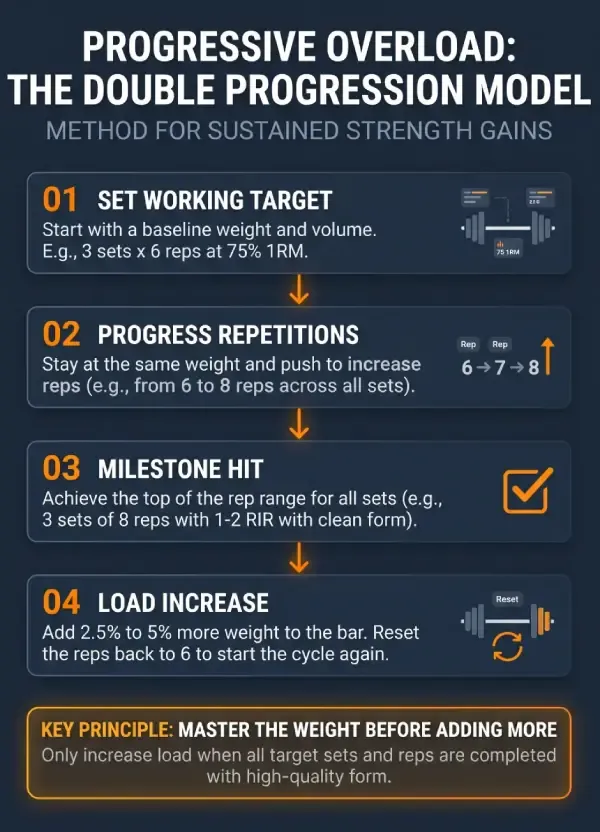
- Use the double progression method: select a target rep bracket (such as 6 to 8 reps). When you can complete 8 clean repetitions across all programmed sets, increase the barbell load by 2.5% to 5% in your next session.
A dose-response meta-analysis by Schoenfeld and colleagues in the Journal of Sports Sciences (
Schoenfeld et al., 2017) demonstrated that performing 10 or more weekly sets per muscle group produces superior hypertrophy compared to lower volumes. Splitting this volume across two workouts per week maintains high movement quality and rep speed on every set.
Lifters seeking a structured program can consult our
Full Body Strength Compound Barbell Routine or our
Advanced Powerlifting Routine. If your priority is muscular size, review our
Muscle Building hub for periodization frameworks. Building new muscle tissue also requires nutritional support: use the
FitWay Daily Calorie & TDEE Calculator to set a modest caloric surplus with 1.6 to 2.2 grams of protein per kilogram of body weight.
Managing systemic fatigue and axial loading in heavy compound training
Compound exercises provide training efficiency, but they also generate systemic fatigue. Spinal compression (axial loading) from heavy back squats and deadlifts taxes the central nervous system and lumbar stabilizers more than machine work. Managing fatigue prevents overuse issues and ensures steady progress.
Apply these four principles when organizing your training week:
- Space axial loading sessions at least 48 hours apart. Avoid pairing heavy squats and conventional deadlifts on consecutive days.
- Alternate spinal-loaded exercises with supported movements. If you squat heavily on Monday, use chest-supported rows or lat pulldowns rather than bent-over rows to give your spinal erectors rest.
- Take 2 to 3 minutes of rest between heavy compound sets. This allows ATP and phosphocreatine stores to regenerate, enabling you to produce maximum force on subsequent sets.
- Schedule a planned deload every 6 to 8 weeks. Reduce training volume by 40% to 50% and decrease working weights by 10% for one week to allow joint cartilage, tendons, and neurological pathways to recover.
Trainees who manage fatigue and master movement mechanics find that compound lifts deliver consistent size and strength gains without recurring joint ache or burnout.
Conclusion
Compound exercises represent the most efficient foundation for full-body hypertrophy training. Movements like the barbell back squat, conventional deadlift, bench press, and overhead press train multiple kinetic chains simultaneously, producing the mechanical tension necessary for muscle growth.
Master your lifting technique, track your loads in a logbook, and apply double progression consistently. Anchoring your weekly routine to these seven compound lifts and fueling your body with sufficient calories and protein establishes the foundation for a lean, powerful physique.
Frequently Asked Questions
Can you build a complete physique using only compound exercises?
Yes, compound exercises stimulate every major muscle group across the body and provide sufficient mechanical tension for full-body muscular development. Major multi-joint lifts like squats, deadlifts, bench presses, and pull-ups build the chest, back, shoulders, legs, and core stabilizers effectively. However, intermediate and advanced trainees often add targeted isolation work, such as lateral raises for the side deltoids or bicep curls, to address specific lagging muscles or maximize regional muscle growth.
Most lifters make optimal progress performing two to three compound exercises per training session. Because multi-joint lifts demand high levels of central nervous system recruitment and produce substantial systemic fatigue, attempting four or five heavy compound movements in one workout leads to declining technique and increased injury risk. A balanced structure pairs one heavy primary lift (such as a squat or bench press) with one or two complementary multi-joint movements, followed by one to two isolation exercises.
What is the ideal rep range for barbell compound lifts?
The ideal repetition range for compound exercises depends on the specific movement and training goal. For primary lifts involving heavy spinal loading, such as squats and deadlifts, working in the 5 to 8 repetition range at 70% to 82% of your 1RM maximizes mechanical tension and strength gains while keeping technical breakdown minimal. For upper-body pressing and rowing movements, such as bench presses, overhead presses, and barbell rows, sets of 6 to 12 repetitions provide an optimal balance between mechanical tension, metabolic stress, and joint comfort.