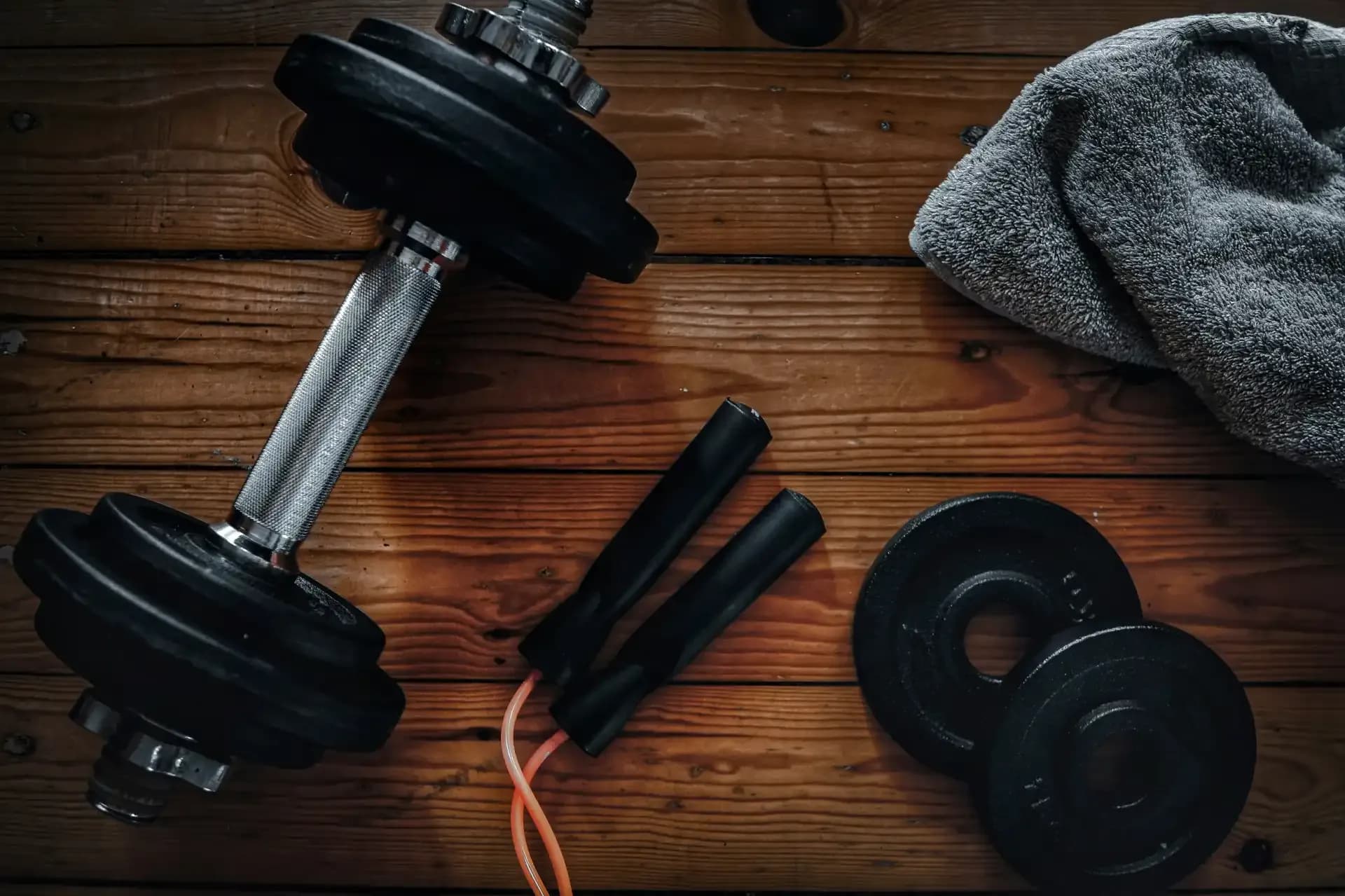
Beginner Toning Workout at Home: 8 Exercises with Dumbbells & Resistance Bands
A 35-minute beginner toning workout you can do at home with light dumbbells and a resistance band. Eight full-body exercises designed to firm and define muscles without bulk — perfect for anyone starting their fitness journey.
Exercise List (8)
Dumbbell Sumo Squat
3 Sets • 15–20
No animation available
Form Preview
Execution Technique
"Stand with feet wider than shoulder width and toes pointing out at 45 degrees. Hold a single dumbbell vertically with both hands at chest height, or hold one dumbbell in each hand hanging between your legs. Brace your core and keep your chest tall throughout the movement. Push your knees out in line with your toes as you sit down into the squat — the wide stance and outward toe angle shift emphasis to the inner thighs and glutes compared to a standard squat. Descend until your thighs are at or near parallel to the floor. Drive through your entire foot to stand, squeezing your glutes hard at the top for a full second. Lower with a controlled 3-second descent on every rep."
Pro Tips
The sumo stance specifically recruits the adductors and gluteus medius more than a standard squat — these are the muscles responsible for the inner thigh and outer hip definition that most toning programs target. Squeeze the glutes actively at the top rather than simply standing up; this peak contraction is what creates the muscle stimulus at the shortened position.
Avoid
Allowing the knees to cave inward — push them outward actively throughout the entire movement. Squatting to a shallow depth, which removes the adductor and hamstring stretch that makes this variation effective. Leaning the torso excessively forward, which shifts load from the legs to the lower back.
Resistance Band Glute Kickback
3 Sets • 15 per side
Dumbbell Lateral Raise
3 Sets • 12–15
Dumbbell Romanian Deadlift
3 Sets • 12–15
Resistance Band Seated Row
3 Sets • 15–18
Dumbbell Overhead Tricep Extension
3 Sets • 12–15
Resistance Band Side-Lying Hip Abduction
3 Sets • 20 per side
Dumbbell Bicycle Crunch Hold
3 Sets • 12 per side
Toning is one of the most searched fitness goals and one of the most misunderstood. The look people associate with a toned physique — defined muscles, firm limbs, visible shape — comes from two things happening simultaneously: building or maintaining lean muscle tissue, and reducing the body fat percentage that sits over it. No exercise creates a physiologically distinct type of muscle contraction that produces firmness. What changes is the ratio of muscle to fat in a given area. This program addresses both sides of that equation.
This 35-minute session uses light dumbbells and a resistance band to create enough mechanical tension to stimulate and preserve lean muscle, while keeping rest periods short enough to elevate heart rate and contribute to overall calorie expenditure. The combination — moderate load, controlled tempo, brief rest — is what makes toning programs effective. It is not a cardio session, and it is not heavy strength training. It sits deliberately between the two.
Rep ranges of 12–20 are used throughout. Higher rep ranges with moderate weight create significant metabolic stress in the muscle — the burning sensation you feel at the end of a set — which is one of the three primary drivers of muscle development alongside mechanical tension and muscle damage. This is also the rep range most associated with muscular endurance improvements, which means you will get stronger at everyday activities alongside the aesthetic changes.
Rest periods are kept to 45–60 seconds. This is intentionally shorter than a pure strength program. The mild fatigue that accumulates between sets keeps your heart rate elevated, adds to total calorie burn, and creates the metabolic stress that contributes to the toned appearance over time. Do not extend rest periods beyond 60 seconds unless technique is breaking down.
Tempo matters more in a toning program than in most other training styles. Use a 2-second concentric (lifting) and 3-second eccentric (lowering) on every rep. Slowing the eccentric phase increases time under tension, which amplifies the muscle stimulus without requiring heavier weights — critical for home training where loading options are limited.
The resistance band exercises are not filler. The band creates constant tension through the full range of motion — something dumbbells cannot do — and is particularly effective for the glutes and hip abductors, areas that respond well to this type of continuous load.
For best results, train this program 3–4 times per week. Pair it with a mild caloric deficit of 200–300 kcal below maintenance if fat loss is part of your goal, and ensure you are eating at least 1.4–1.6g of protein per kilogram of bodyweight daily to preserve the muscle you are building. The toned appearance develops over 8–12 weeks of consistent training — not faster, but reliably.
Expert Tips
- •Combine moderate weights with higher repetitions (12-15 reps).
- •Incorporate supersets to keep intensity high.
- •Maintain a balanced diet to reduce body fat while keeping muscle.
Common Mistakes
- ×Believing you can 'spot reduce' fat from specific areas.
- ×Using weights that are too light to stimulate the muscle.
- ×Relying solely on isolation exercises instead of compound lifts.
Reviews
Based on 0 reviews
Leave a Review
Recent Reviews
Loading reviews...
Recommended For YouView All
Upgrade to Pro
Get unlimited access to all workout programs and expert nutrition plans.